

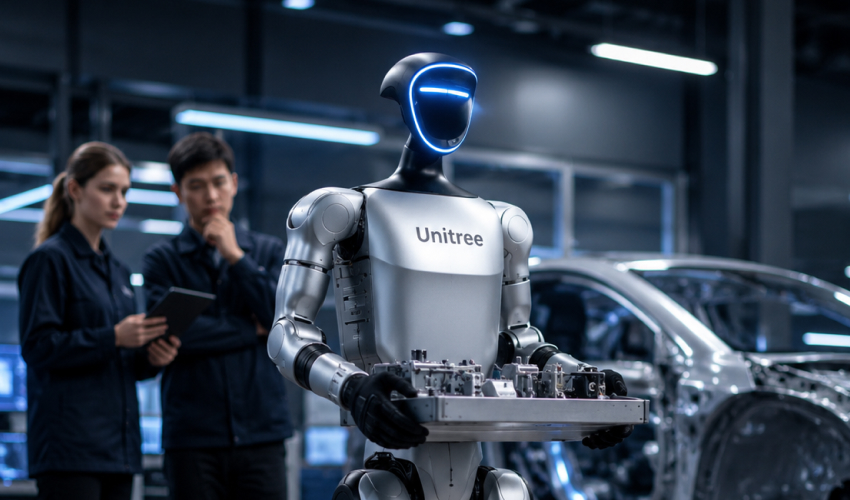
Is Unitree G1 Better Value Than Premium Humanoids?
Humanoid robotics is attracting automotive scale capital, but much of the premium market remains locked behind internal programs and controlled pilots. G1 changes the economics by giving universities, startups, and enterprise R&D teams direct access to configurable humanoid hardware at a much lower capital threshold.
Discover how robots can better your life!
Why is humanoid value harder to measure in 2026?
The humanoid market has an unusual pricing problem. Some of its most technically ambitious platforms are backed by enormous capital and industrial partnerships, yet ordinary research teams cannot simply purchase them, instrument them, and begin testing.
At the same time, the unitree g1 robot has pushed commercial humanoid ownership into a materially lower price bracket. MotorTrend highlighted the same market shift in its teardown and pricing analysis, noting both G1’s accessible entry point and the significantly higher cost of development oriented configurations.
That changes the buyer’s decision.
The real buying decision is no longer which robot looks most advanced in a launch video. It is which platform produces the most useful engineering output inside the buyer’s budget, facility, team capability, and development timeline.
Why does G1 change the economics?
G1 gives buyers a staged entry into humanoid robotics.
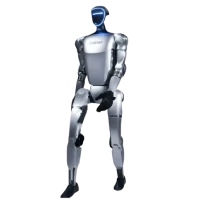
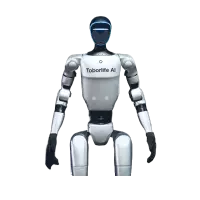
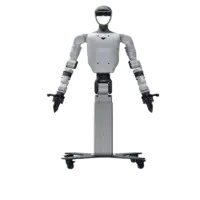
Toborlife AI currently lists G1 Basic at $17,990. The platform uses a compact 1.32 meter, approximately 35 kilogram body with 23 degrees of freedom, depth sensing, 3D LiDAR, an eight core CPU, Wi Fi 6, Bluetooth 5.2, a quick release battery, and roughly two hours of runtime.
G1 Basic solves the evaluation problem through a compact bipedal form factor that allows labs and enterprise teams to study humanoid motion, perception, demonstrations, and physical interaction without taking on the facility footprint of a full scale industrial humanoid.
Product specification:
https://toborlife.ai/g1/
That matters because a robotics budget does not end with the purchase order. Every dollar committed to unused mechanical capability is a dollar unavailable for simulation, developer time, sensing, safety systems, data infrastructure, spare planning, and experimental cycles.
Where do premium humanoids earn their cost?
Premium humanoid programs make sense when the target problem is already expensive enough to justify deep vertical integration.
Automotive manufacturing is a good example. Factory operators care about cycle time, intervention rate, uptime, safety validation, recovery behavior, fleet management, and measurable labor economics. MotorTrend’s analysis points directly to the automotive sector’s growing investment because factories provide structured environments where those metrics can be quantified.
A premium platform earns its cost when better actuators, thermal engineering, autonomy, fleet software, or industrial validation materially improve production output.
That standard is much harder than demonstrating that a robot can walk, carry an object, or execute a choreographed sequence.
The right robot depends on the environment, not only the spec sheet.
Is lower acquisition cost the same as better value?
No. Value comes from productive utilization.
Total Cost of Ownership includes batteries, charging routines, spare parts, safety infrastructure, operator training, software integration, maintenance, floor space, developer labor, and downtime.
The better question is what each dollar of TCO buys.
A university that runs 500 controlled experiments on a commercially accessible platform can generate more strategic value than an organization that secures a premium robot but lacks the software team or deployment architecture to exploit it.
The market rewards learning velocity.
A lower capital threshold lets teams begin producing physical datasets earlier, expose failure modes faster, validate operator workflows sooner, and kill weak use cases before they consume a larger budget.
That is how capital efficiency compounds in embodied AI.
Discover how robots can better your life!
When should a buyer move beyond the Basic configuration?
Software access should drive the upgrade.
G1 Basic carries 23 degrees of freedom and does not include the secondary development layer available on the EDU configurations. Current Toborlife G1 EDU tiers add 100 TOPS AI compute and progressively richer articulation and hand options.
Once a program requires custom perception, teleoperation, manipulation, learned policies, or proprietary data capture, the developer stack becomes part of the core product rather than an accessory.
G1 Edu Pro F addresses advanced manipulation work with 35 degrees of freedom, tactile BrainCo five finger hands, 100 TOPS compute, and secondary development access, giving research teams a richer control surface without forcing the facility burden of a larger humanoid platform.
Configuration specification:
https://toborlife.ai/g1-edu-pro-f/
This is where the comparison gets interesting. Paying more is rational when the added configuration compresses engineering time. Paying more for unused articulation or compute simply increases TCO.
Which buyers get the strongest return from G1?
The strongest fit sits with organizations that need access and iteration more than immediate labor substitution.
1. Universities gain a real bipedal platform for controls, perception, locomotion, teleoperation, reinforcement learning, and human robot interaction.
2. Robotics startups can pressure test software and control architecture before committing capital to proprietary hardware.
3. Enterprise innovation teams can validate use cases, safety procedures, operator workflows, and physical datasets before entering pilot to production pipelines.
4. Demonstration teams can achieve credible humanoid presence without paying for a development stack they will never use.
The strongest use case is not always the flashiest one.
If a robot lets an engineering team invalidate a poor automation thesis in four weeks, it has protected more capital than a polished demonstration that produces no transferable insight.
What should procurement teams compare besides price?
The shortlist should be built around six operating questions.
- Development access must match the level of control the engineering team actually needs.
- Mechanical scale must match the workspace rather than a preference for visual presence.
- End effectors must match the objects, contact forces, and manipulation tasks under study.
- Battery architecture must sustain the planned experiment cadence.
- Safety and recovery procedures must reflect falls, contact, operator intervention, and floor conditions.
- Data infrastructure must convert experiments into reusable physical datasets.
These inputs define hardware software integration overhead.
They also expose whether the program is ready to scale or still needs a cheaper learning cycle.
Does humanoid robot g1 beat premium platforms?
For open research, university deployment, startup development, and enterprise evaluation, G1 has a structural advantage because buyers can procure the hardware, work directly with it, and expand capability as the program matures.
For production labor, premium engineering has to earn its cost through measurable operating performance.
That means sustained throughput, lower intervention rates, higher uptime, controlled recovery, validated safety, and stronger economics inside the specific task.
A premium humanoid wins when those attributes materially change production output. G1 wins when faster access, lower capital exposure, and development flexibility create more value than waiting for a larger platform or commercial program to become accessible.
Why does the U.S. distribution layer matter?
This is where Toborlife AI becomes relevant for U.S. buyers.
A humanoid procurement decision involves more than SKU selection. Compute tier, developer access, hand architecture, battery strategy, operating environment, expected wear, logistics, support exposure, and future expansion all need to line up before capital is committed.
Toborlife AI has already done that diligence across the Unitree portfolio.
The result is a cleaner path from technical evaluation to deployment because the buyer does not have to reverse engineer configuration logic, logistics, and implementation requirements after the robot arrives.
That is the role of a high value U.S. distributor in an emerging hardware category. Remove preventable friction before it consumes engineering time.
G1 portfolio:
https://toborlife.ai/all-g1-models/
Toborlife AI:
https://toborlife.ai/
U.S. technical procurement:
https://toborlife.ai/contact/