What Does a Useful Teleoperation Dataset Require?
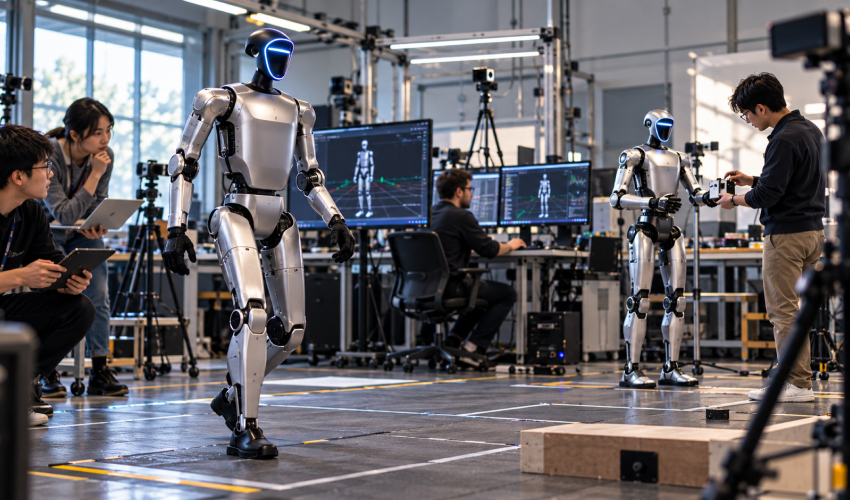
A teleoperation demonstration is more than a video of a robot completing a task. A research team may need time-aligned operator inputs, joint states, camera observations, task labels, and records of failures or interventions. Those signals must be accessible at a useful frequency and with documented timing if the resulting dataset is intended for reproducible experiments.
A 2026 study of a Unitree G1 Edu human-interaction mimicry pipeline illustrates this system-level challenge. Its approach combines external RGB-D sensing, mapping software, and robot control. The research demonstrates a particular experimental implementation, not a universal capability included with every G1 or a guarantee of autonomous task completion.
Before choosing hardware, researchers should define the control signals they need, the objects they will manipulate, the recording format, and the safety conditions under which demonstrations can be repeated.
How Does G1 Basic Compare With G1 Edu for Development Access?
The September 2026 distributor workbook lists G1 Basic with 23 joint degrees of freedom, dummy hands, an eight-core processor, a depth camera, and 3D LiDAR. Crucially, it identifies secondary development as unsupported for that configuration. Toborlife’s approved G1 Basic copy likewise positions the model primarily for controlled interaction and demonstrations.
G1 Edu Standard, labeled G1 Edu Pro in the distributor workbook, is described as supporting high-level and low-level secondary development, with a 100-TOPS computing unit. Those distinctions make the Edu configuration the more relevant starting point when a research protocol requires custom control or onboard algorithms.
However, development support is not a blanket promise that every sensor stream, control rate, or software package is available. A lab must confirm the actual interfaces, SDK permissions, firmware requirements, and logging methods for its exact robot before designing a data-collection pipeline around them.
The purchase should be specified by configuration name and supported interfaces, not simply by the phrase g1 humanoid robot.
Do Manipulation Experiments Require Different Hands?
The standard G1 Basic configuration uses dummy hands. These are appropriate for certain gestures and demonstrations but do not provide the articulated grasping functions required by many manipulation experiments.
A laboratory studying object transfer, contact-rich motion, or hand-object coordination should identify the required end effector before selecting its G1 Edu variant. Different Edu configurations can include different arm and hand hardware. Researchers should verify finger actuation, sensing, payload limits, and compatible control interfaces for the exact option they intend to buy.
A dexterous hand alone does not produce a manipulation dataset. The experiment also needs calibrated observations, task fixtures, suitable objects, human supervision, and procedures for handling unsuccessful grasps. The objective is to capture repeatable physical interactions, not merely to display a robot holding an object.
How Should Teams Plan the Unitree G1 Battery Workflow?
A unitree g1 battery is part of the experimental schedule, not just an accessory line item. The approved G1 Basic copy describes a quick-release 9,000 mAh battery and approximately two hours of nominal runtime. Those figures should not be applied automatically to every Edu configuration or to a continuously operating manipulation workload.
For data collection, useful operating time is the interval in which the robot is ready, the recording system is synchronized, and a safe task can be performed. Battery changes, calibration, operator breaks, software resets, and data checks reduce the number of usable trials in a day.
A lab should estimate the duration of each demonstration, the expected reset time, and the number of repetitions needed for analysis. Spare batteries and charging arrangements may matter, but availability and compatibility must be verified for the purchased configuration.
Why Is G1 Price Only One Part of the Research Budget?
Teams searching for unitree g1 price information or planning to buy unitree g1 hardware should distinguish the robot’s acquisition cost from the cost of running a useful research program.
The budget may include development-capable hardware, compatible hands, operator interfaces, external cameras, data storage, safety barriers, test objects, software engineering, and staff time. Some of these items are optional for demonstrations but essential for manipulation-focused data collection.
A cheaper robot can become an expensive choice if it cannot expose the signals the experiment requires. Conversely, a sophisticated configuration may be unnecessary for a laboratory whose primary objective is public engagement or controlled movement demonstrations.
The correct purchasing metric is not the lowest advertised unit price. It is the cost of obtaining a complete, supportable experimental configuration that can produce the observations the research team needs.
Which G1 Should a Physical AI Lab Choose?
G1 Basic is better suited to teams seeking a controlled demonstration platform without custom secondary development. G1 Edu is the more appropriate category for research teams developing teleoperation, robot control, and data-collection workflows, provided the exact configuration supports their required interfaces and end effectors.
For laboratories planning a manipulation dataset, compare the G1 configurations available through Toborlife AI and review the teleoperation information as a separate workflow component. Confirm the robot, hands, control access, and recording requirements together before placing an order.

Comments are closed for this post.