What Should a First Humanoid Robotics Course Actually Teach?
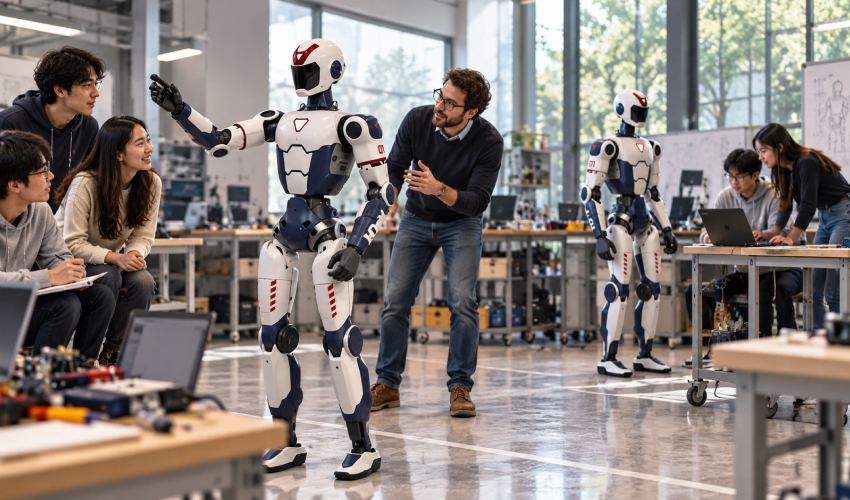
A department planning its first teaching lab should define the activities students must complete by the end of the term. An introductory robotics course might examine humanoid kinematics, locomotion principles, perception, and safety through instructor-led demonstrations. Students could analyze recorded observations, compare robot movements with simulation, or discuss the limits of onboard sensing without writing code that directly controls the machine.
A capstone course creates a different requirement. Students may need to build and test control software, process sensor outputs, or investigate how changes to a motion algorithm affect robot behavior. Those activities depend on documented development interfaces and access permissions, not merely the robot’s ability to move.
The Education University of Hong Kong’s July 2026 report on an R1 assembly and demonstration session offers a useful educational example. It describes hands-on familiarization with humanoid hardware, but it should not be interpreted as evidence that every R1 configuration supports the same student programming workflow.
How Do R1 Basic and R1 Edu Standard Differ for Students?
The September 2026 distributor specification workbook identifies the R1 Basic as a compact humanoid with an eight-core processor, binocular vision, wireless connectivity, and a quick-release smart battery. Its documented configuration does not support secondary development. That limitation matters if the course requires students to create their own low-level control or research software.
R1 Edu Standard is the development-oriented alternative. The same workbook identifies support for secondary development and an expansion computing system rated at 40 TOPS. These features make it a more relevant candidate for classes that require student-built algorithms, subject to the actual software documentation and interfaces supplied with the selected unit.
Neither configuration should be described as a turnkey autonomous teaching assistant. Instructors still need to establish safe operating procedures, suitable experiments, and clear boundaries between observing built-in behavior and programming new functionality.
A department should also verify the exact model before ordering. Older R1 product copy contains conflicting degrees-of-freedom and weight descriptions; these differences should not be silently combined into a single specification.
Which Configuration Fits Three Common Teaching Scenarios?
For an introductory demonstration course, R1 Basic may be the more economical educational choice if instructors primarily need to show humanoid movement and discuss robot architecture. The learning value comes from structured observation, measured demonstrations, and analysis, rather than unrestricted programming access.
For a supervised programming laboratory, R1 Edu Standard is the stronger candidate because secondary development is part of its documented configuration. Before selecting it, the department should confirm what students can read and control, which development tools are available, and whether the proposed exercises are supported by the delivered software.
For semester-long capstone projects, the selection should start with the project brief. A team studying motion planning needs different access from one exploring perception or human-robot interaction. Even with R1 Edu, students may need additional computing, fixtures, safety equipment, or simulation tools to produce meaningful results.
The R1 humanoid robot is therefore best evaluated as part of a course design, not as an isolated technology purchase.
How Should Universities Plan Shared Lab Time and Safety?
A single robot shared by several student teams creates a scheduling problem. Setup, battery changes, inspection, supervised operation, and experiment recovery all consume laboratory time. The distributor workbook describes approximately one hour of battery life for the R1 configurations discussed here, but real session length will depend on the activity and operating conditions.
Departments should plan for short, repeatable sessions rather than assuming a full class period of uninterrupted movement. A useful lab protocol defines who may operate the robot, how the workspace is cleared, when a session must stop, and how data or observations are recorded.
Students also need a baseline. If every group changes several parameters without restoring a known configuration, the results become difficult to compare. Version-controlled code, standardized test sequences, and instructor-approved operating limits can make shared hardware more educationally productive.
The procurement budget should therefore include staff preparation, protected operating space, computing equipment, and time for maintenance and recovery. A lower initial hardware price cannot compensate for a course whose intended experiments the robot cannot support.
What Should a University Confirm Before Ordering?
The most useful procurement document is a one-page curriculum-to-capability matrix. For every planned assignment, specify whether students must observe, command, program, or collect data from the robot. Then request confirmation of the exact configuration, development permissions, available documentation, battery provisions, and required accessories.
Universities should also distinguish optional computing modules from included hardware and verify whether the configuration they are purchasing matches the one described in their course proposal.
Where Should an Academic Robotics Team Start?
Choose R1 Basic when the primary objective is instructor-led demonstrations and foundational discussion of humanoid robotics. Evaluate R1 Edu Standard when students must develop and test their own algorithms through supported interfaces. The right choice is the one that delivers the learning activities the syllabus promises.
For departments planning a first humanoid teaching lab, review the Unitree R1 Basic and R1 Edu Standard product information at Toborlife AI, then map the exact configuration against your course requirements before purchasing.

Comments are closed for this post.