Why Teleoperation Data Matters for Humanoid Training
Humanoid robots learn many manipulation and whole-body skills from human demonstrations. An operator performs a task through the robot, the system records it, and a model learns from many repetitions.
The quality of that dataset depends on the operator. If control feels awkward, demonstrations come out hesitant and inconsistent, and the model learns the hesitation. If control feels natural, the operator moves with intent, and each run looks like the last. Smooth Unitree G1 teleoperation produces better training data.
What’s in the Tobor Harness Teleoperation Kit
The Unitree G1 teleoperation kit ($15,000 MSRP) includes:
1. PICO 4 Ultra headset for an immersive first-person view through the robot’s cameras
2. Two PICO 4 motion trackers for lower-body tracking
3. Integrated teleoperation software and control system for dexterous manipulation and whole-body control
Toborlife AI designs and manufactures Tobor Harness. The kit pairs with the G1 Edu and is positioned for advanced research and education programs.
Whole-Body Control: Arms, Hands, and Legs Together
Many teleoperation setups control the arms and leave the robot standing still. Tobor Harness drives the whole robot. The operator’s arm and hand motion maps to the G1’s arms and dexterous hands. Leg trackers capture lower-body movement, so the operator can walk the robot through a space and reposition it mid-task.
Whole-body control (WBC) keeps the G1 balanced as the operator reaches, bends, and steps. That widens the range of tasks a team can demonstrate: picking an item off a low shelf, carrying it across a room, and placing it on a table, all in one continuous session.
Dexterous hand control lets operators demonstrate fine manipulation. Grasping, turning, and handing over objects become part of the dataset alongside locomotion.
Smooth, Low-Latency Unitree G1 Teleoperation
Responsiveness is what operators notice first. Tobor Harness keeps the delay between operator movement and robot response low enough that control feels direct. Operators correct grasps as they happen and keep a steady rhythm across repeated demonstrations.
Stereo vision from the G1 gives the operator depth through the headset. Judging distance to an object takes less guesswork, so reaches land closer to target on the first try. Less correction mid-motion means cleaner trajectories in the recorded data.
Operators also tire less when control feels natural. Longer, steadier sessions mean more usable demonstrations per day, and fewer runs thrown out during data review.
What a Unitree G1 Teleoperation Session Looks Like
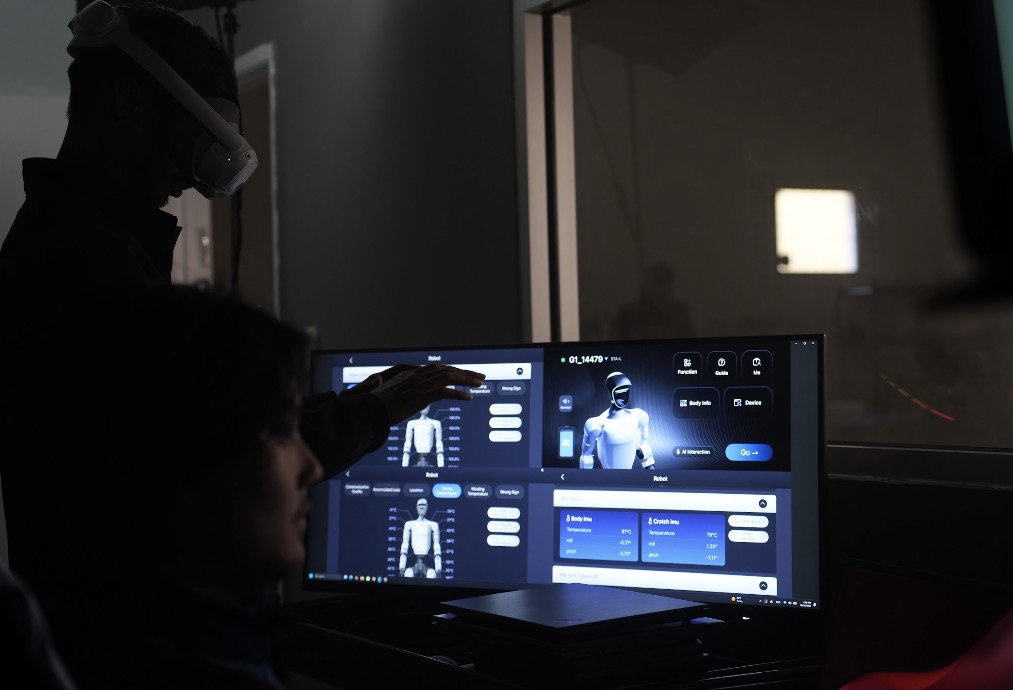
A session starts with calibration. The operator puts on the headset and trackers, and the system aligns their posture with the G1’s. From there, the operator sees through the robot’s cameras and starts working.
A typical data collection block runs one task many times. Pick up the cup, move it, set it down, return to start. The research team watches the runs, flags any that went wrong, and adjusts the setup between blocks.
At the end of the day, the team has a set of demonstrations recorded from the same robot, the same operator, and the same scene. That consistency is what makes a dataset useful for training.
Built for Data Collection and Training
Tobor Harness is a data collection tool first. It produces the demonstration data that trains AI models. Each session records how a skilled operator performs a task through the robot’s own body, cameras, and joints.
Because the demonstrations come from the G1 itself, the data matches the hardware a team will deploy policies on. Research groups use this kind of data for imitation learning, policy training, and evaluation of manipulation and locomotion methods.
From Unitree G1 Remote Control to Full-Body Teleoperation
Every G1 ships with a handheld remote for basic Unitree G1 remote control: walking, turning, and preset motions. That’s useful for moving the robot around a lab. It doesn’t capture how a person would perform a task.
Full-body teleoperation does. The operator’s own movement becomes the robot’s movement, which is what demonstration-based training needs. Remote control moves the robot. Teleoperation teaches it.
Research and Development Uses
1. Imitation learning datasets: record repeated demonstrations of household, lab, or industrial tasks
2. Dexterous manipulation research: capture hand motion for grasping and in-hand manipulation studies
3. Whole-body skill studies: demonstrate tasks that combine walking, reaching, and carrying
4. Human-robot interaction: run studies with a human-driven humanoid in the room
5. Task prototyping: test whether a task is feasible on the G1 before investing in autonomy
Getting Set Up with Unitree G1 Teleoperation
Toborlife AI is an official Unitree partner in Mountain View, California. We help research teams get set up with Unitree G1 teleoperation, from configuring the G1 Edu to calibrating the harness and running first data collection sessions. After-sales support and repairs come from Unitree-trained technicians in North America.
Ready to start collecting whole-body data on the G1? Talk to a Robotics Expert →

Comments are closed for this post.