What Does “Deployment-Ready” Actually Mean in 2026?
Deployment-readiness should not be confused with mobility, speech, or a polished demonstration sequence. A deployable humanoid needs to stay effective inside a defined operating domain, recognize when conditions have drifted outside that domain, hand control back safely when needed, and reproduce acceptable performance across changes in surfaces, lighting, network quality, surrounding people, and object variability.
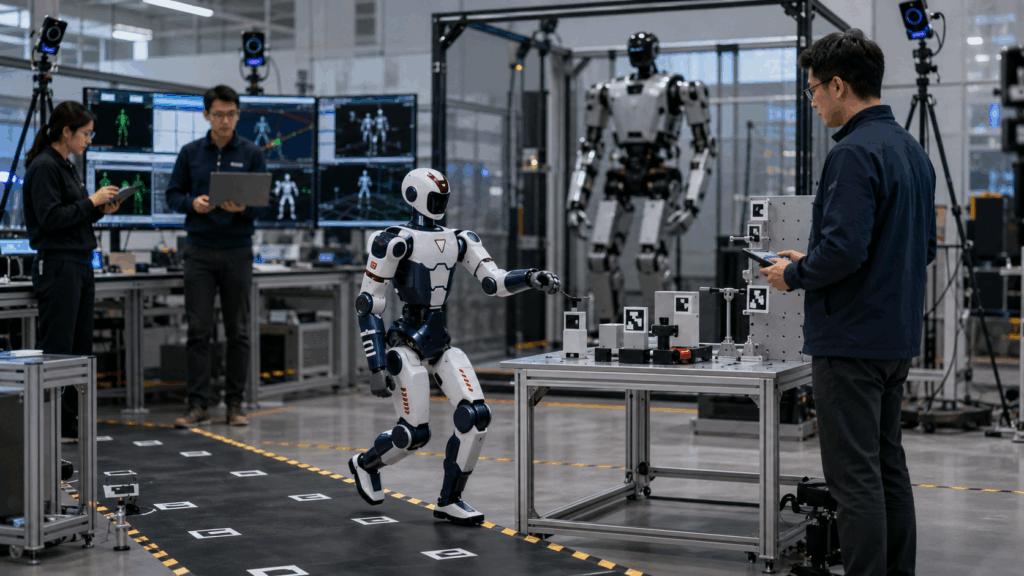
For research teams, that evaluation should be pressure-tested across four layers:
1. The autonomy stack should expose confidence boundaries, intervention logic, and failure modes instead of hiding operator dependence behind a clean demo.
2. The physical platform should remain controllable through slips, contact events, perception misses, communication instability, and other operational edge cases that appear in real environments.
3. The data architecture should convert experiments into reusable physical datasets with synchronized perception, motion, command, and outcome records.
4. The operating model should account for supervision labor, safety fixtures, compute, maintenance, spare planning, and hardware-software integration overhead within Total Cost of Ownership (TCO).
A humanoid can look impressive while underperforming on several of these dimensions. That changes the buyer’s decision because a research platform creates value through iteration, while a deployment platform only justifies itself when it can sustain repeatable operational output.
Why Does R1 Make Sense for Research-First Labs?
The R1 is strongest when the goal is controlled experimentation rather than human-scale task substitution. Labs working on locomotion, perception, multimodal interaction, reinforcement learning, classroom robotics, or early-stage control systems usually get more strategic value from a platform they can reset quickly and run often than from a larger body that raises safety, infrastructure, and supervision demands from day one.
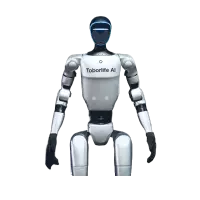
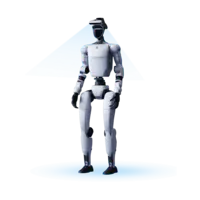
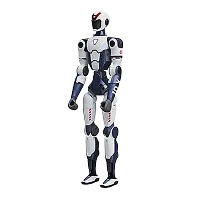
The R1 Edu Smart solves that exact problem through a compact 121 cm, 25 kg form factor with optional 100-TOPS Jetson Orin compute and secondary-development support, giving research teams a manageable humanoid base they can iterate on repeatedly without inheriting the full operational burden of a full-size machine.
That smaller footprint reduces deployment friction across university labs, shared maker spaces, startup facilities, and supervised classroom environments. More importantly, it preserves budget for the assets that usually determine whether a robotics program compounds: sensing, simulation, data tooling, spare planning, developer time, and repeated experimental cycles.
When Does a Full-Scale Humanoid Become the Better Research Bet?
A larger humanoid becomes more relevant when body scale is no longer incidental to the research question. If the program involves industrial reach, adult-height workspaces, stronger contact forces, payload handling, human-facing ergonomics, or whole-body balance under meaningful external load, a compact humanoid will not fully represent the target environment.
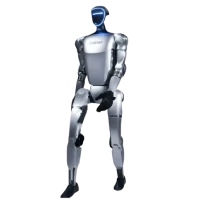
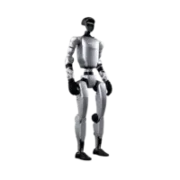
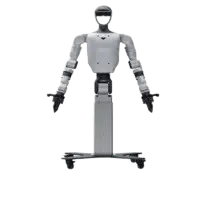
The H2 addresses that requirement with a roughly 182 cm, 70 kg chassis, high-torque joints, optional dexterous hands, and Jetson AGX Thor compute, making it the better fit when the lab needs to validate human-scale reach, payload interaction, or force-sensitive full-body control.
That benefit comes with a different engineering burden. Once the robot moves into this class, safety zoning, fall recovery, transport, floor loading, recovery workflows, operator training, and liability controls stop being side considerations and become part of the actual system architecture.
Which Platform Creates More Research Value?
The better question is not just what the robot can do. The better question is where it fits inside the institution’s pilot-to-production pipeline.
1. Choose the R1 path when the goal is algorithm development, experimentation, education, or early embodied AI research, because the platform supports faster iteration and lower-risk testing.
2. Choose the R1 when the team is still shaping its use case, because a smaller humanoid limits sunk-cost exposure while the program clarifies which behaviors, interfaces, and autonomy layers matter.
3. Choose a full-scale humanoid when body scale changes the validity of the experiment, especially in payload, reach, contact mechanics, or workspace realism.
4. Treat deployment claims cautiously until repeatability is demonstrated, because a larger machine does not compress the autonomy roadmap if the real bottleneck is still manipulation, safety validation, perception robustness, or recovery logic.
Teams deciding whether to buy R1 robot hardware should start with the experiment portfolio, not the demo reel. The R1 usually produces stronger capital efficiency for learning-intensive programs, while a larger humanoid earns its cost only when the lab can clearly explain why human-scale mechanics materially improve the research outcome.
Why Does the Seller Layer Matter for U.S. Labs?
A serious R1 robot distributor should do more than move a box from inventory to a loading dock. U.S. buyers need the hardware configuration, compute tier, development access, warranty path, facility fit, and research objective to be aligned before the system arrives.
That is where Toborlife AI becomes relevant. Toborlife AI has already done the diligence required to position Unitree-powered platforms inside real buyer environments rather than as generic catalog items. For labs comparing R1 against larger humanoid systems, that means a cleaner procurement process, fewer mismatches between ambition and configuration, and a far more credible path from first evaluation to long-term robotics work.
Before the budget is finalized, teams can talk with our team to align compute requirements, secondary-development scope, facility constraints, safety planning, and data-collection goals so the robot enters the lab as part of a deliberate research architecture, not as an isolated purchase.



Comments are closed for this post.