Why Is Body Scale Now a Software Decision?
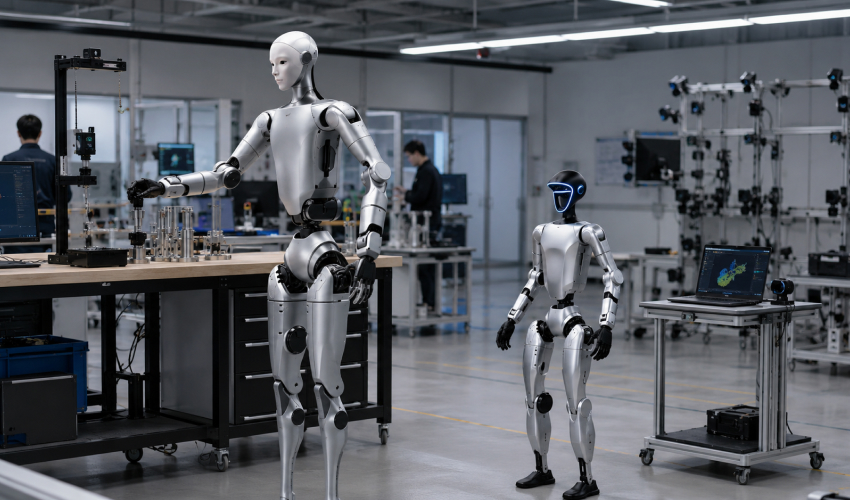
Embodiment shapes the information a model receives. Reach changes the accessible workspace. Mass changes balance and recovery. Joint architecture changes available motion. Hand configuration changes the manipulation problem itself.
This is where the comparison gets interesting. A larger humanoid creates a different experimental envelope, but that envelope also introduces different safety controls, recovery procedures, facility requirements, and operational edge cases.
The real buying decision is whether scale changes the validity of the experiment.
Why Does G1 Fit High Cadence AI Research?
For this buyer group, the logical compact shortlist is G1 Edu Pro F, rather than the broader G1 catalog.
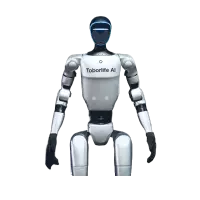
The G1 Edu Pro F solves the high cadence manipulation problem through its compact humanoid body, secondary development access, onboard AI compute, three dimensional sensing, and tactile five finger hands, allowing teams to cycle through grasping, teleoperation, perception, and control experiments without designing the entire laboratory around a full size machine. Toborlife’s current configuration confirms secondary development support, dedicated AI compute, 3D sensing, and tactile five finger manipulation hardware.
That smaller footprint reduces deployment friction around transport, resets, shared laboratory use, supervised testing, and fall management. More experimental cycles can produce richer physical datasets and stronger embodied AI deployment velocity when the research objective is learning intensive.
For imitation learning, teleoperation, grasp development, reinforcement learning, multimodal interaction, and manipulation research, iteration frequency can matter more than human scale geometry.
When Does H2 Become the Better Physical AI Instrument?
The shortlist changes when body scale becomes part of the research question. Adult workspaces, longer reach envelopes, greater contact forces, whole body interaction, and realistic human environment validation demand a different physical platform.
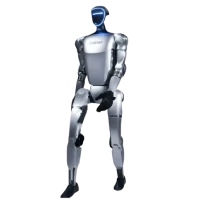
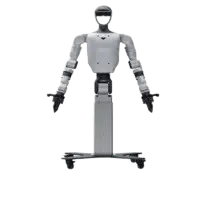
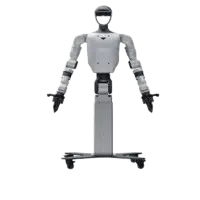
The H2 Edu solves that validation problem through its full size humanoid form, higher joint torque class, configurable manipulation hardware, secondary development support, and configurable high performance compute, giving researchers the mechanical envelope required to investigate adult scale reach, larger force regimes, and whole body interaction. Toborlife’s current H2 information distinguishes the development focused EDU configuration from the standard H2 configuration, particularly around development support, compute, and configurable hands.
That larger embodiment also expands the engineering burden. Safety zoning, recovery planning, operator authority, workspace clearance, transport, and experiment design become part of the system architecture.
This is why unitree h2 vs unitree g1 should be evaluated through experimental validity rather than visual sophistication.
Which Platform Produces More Valuable Physical Datasets?
Neither platform wins by default. Dataset value depends on whether the body captures the variables the model must eventually control.
Physical AI development depends on synchronized information across perception, motion, command, contact, intervention, and outcome. The industry’s push toward better simulation and data infrastructure reinforces this point because real robot data remains expensive to collect and difficult to diversify. From Toborlife AI’s commercial perspective, the data objective should therefore exist before the body configuration is locked.
G1 creates an advantage when experimental repetition dominates the research program. H2 creates an advantage when the target task loses validity without adult scale reach, mass, or physical interaction.
This distinction also shapes pilot to production pipelines. Early research benefits from lower hardware software integration overhead and fast experimental resets. Later validation requires an embodiment close enough to the intended operating environment to expose failures before deployment.
How Should Buyers Think About TCO?
Total Cost of Ownership (TCO) for humanoid research extends far beyond acquisition. Serious programs account for facility preparation, operator time, data infrastructure, safety systems, maintenance planning, compute, integration labor, recovery procedures, and engineering time consumed by failures.
A compact platform protects capital efficiency when the program is still discovering which behaviors deserve investment. A full size platform earns the larger implementation surface when scale produces technical information the smaller system cannot.
The boring questions protect the budget. How many experiments can the team execute in a week? What happens after a failed grasp or balance event? How much operating space does safe testing consume? Which interventions become training assets instead of repeated labor?
What Should Physical AI Teams Choose in 2026?
Choose the G1 research path when rapid model iteration, dexterity experiments, teleoperation, perception, reinforcement learning, or manipulation research defines the program. Choose H2 Edu when adult scale mechanics, reach, contact, force, or workspace realism materially determine whether the results are useful.
That is the practical answer behind the H2 humanoid robot debate. Scale should exist because the research demands it.
A credible Unitree H2 Robot Distributor therefore has to resolve engineering diligence before logistics begin. Toborlife AI has already structured the U.S. buyer path around configuration scope, secondary development, manipulation hardware, compute, facility fit, safety planning, and implementation dependencies so that tier one humanoid hardware enters the lab as deliberate technical infrastructure rather than an isolated capital asset.
Teams approaching procurement can take their experiment portfolio, interaction requirements, data architecture, development scope, and facility constraints directly into Toborlife AI’s engineering and distribution process. That moves configuration risk upstream, where it can still be controlled, and gives the organization a cleaner path from research capital to supportable deployment. Explore Toborlife AI or begin technical procurement through the contact page.


Comments are closed for this post.