Where does the G1 architecture pull ahead?
This is where the comparison gets interesting.
A hand does not operate independently in a human workspace. Reaching a shelf requires the robot to approach the correct position, establish a stable stance, rotate the torso, manage arm extension, orient the wrist, and control contact while preserving balance.
The moment those dependencies matter, a fixed hand rig stops representing the deployment environment.
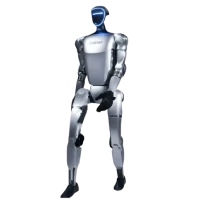
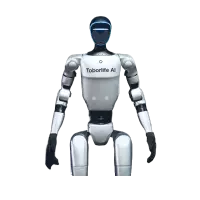
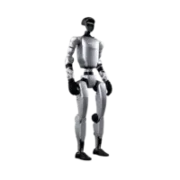
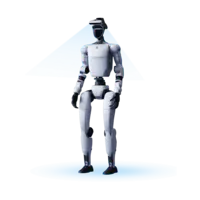
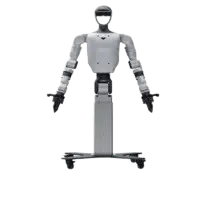
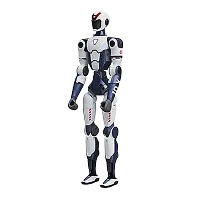
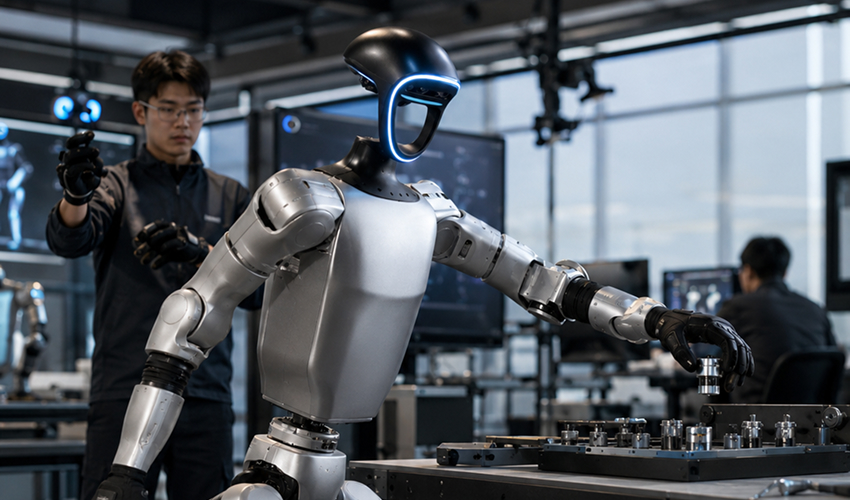
G1 Edu Pro F is built for that broader research surface. The configuration combines 35 degrees of freedom, 100 TOPS of onboard AI compute, secondary development access, and tactile BrainCo five finger hands in a compact humanoid body.
That specific configuration solves the mobile manipulation problem because researchers can study contact and hand behavior while preserving the locomotion, posture, reach, and whole body kinematic constraints that shape real task execution.
Why is whole body data harder and more valuable?
Whole body teleoperation creates a richer dataset because more of the deployment state remains visible.
A successful retrieval task can include:
1. The approach trajectory records how the robot positioned itself before reaching.
2. Joint and torso states reveal how balance changed as the upper body extended.
3. Hand telemetry captures grasp configuration and contact.
4. Vision and depth streams preserve scene context.
5. Operator commands show how a human corrected uncertainty.
6. Fault and recovery states expose where autonomous behavior broke down.
This data is expensive because the system contains more moving parts, more synchronization requirements, and more operational edge cases.
That hardware software integration overhead is not wasted complexity when the target application eventually requires a complete humanoid. It becomes the price of learning the full task rather than one isolated subsystem.
Is remote operation enough for serious research?
Unitree G1 remote control only becomes strategically useful when each intervention teaches the system something.
A basic control session lets an operator complete a task. A serious research architecture preserves synchronized perception, proprioception, commands, contact information, network state, faults, and outcomes so engineers can reconstruct why the robot succeeded or failed.
That changes the economics of human supervision.
Instead of treating operator labor as a temporary workaround, the lab converts that labor into physical datasets for imitation learning, reinforcement learning, policy evaluation, and future autonomy.
This is where embodied AI deployment velocity comes from. Every intervention resolves the immediate task and expands the dataset around conditions the autonomous system could not yet handle.
Which system reaches useful results faster?
The answer depends entirely on the research objective.
For a lab studying finger control, tactile inference, grasp stability, or end effector design, a dedicated hand system eliminates unnecessary mechanical variables and produces faster iteration.
For a lab studying mobile manipulation, human workspace interaction, whole body retargeting, or progressive autonomy, G1 captures the dependencies that eventually determine whether the task works outside the test bench.
The better metric is not raw dataset size. It is the number of reproducible, relevant task episodes generated per engineering hour.
That is a far more useful measure of research velocity than the number of sensors or joints listed on a product page.
How should a lab model TCO?
The Total Cost of Ownership discussion gets serious once engineering labor enters the model.
A hand focused platform carries lower safety and calibration overhead. A whole body platform demands more floor space, operator discipline, battery planning, recovery procedures, data infrastructure, and test orchestration.
But postponing whole body integration has its own cost. If the eventual application requires locomotion plus manipulation, a team that optimizes the hand in isolation can discover later that stance, reach, torso motion, or balance changes the control problem entirely.
The boring questions are usually the ones that protect the budget.
Research leaders should model researcher hours, operator station utilization, failed experiments, calibration time, battery cycles, hardware recovery, dataset quality, and downstream reintegration before comparing acquisition prices.
Which architecture belongs in the lab?
Choose the narrow architecture when the problem is narrow.
A dexterous hand platform is the better instrument for contact mechanics, tactile sensing, grasp policy research, or specialized manipulation where body motion adds noise without adding scientific value.
Choose whole body G1 when the experiment depends on how manipulation interacts with movement, balance, reach, human scale geometry, or operator retargeting.
The strongest use case is not always the flashiest one. The winning architecture is the one that removes the right uncertainty fastest.
What does Toborlife AI change for U.S. research teams?
This is where Toborlife AI becomes relevant for U.S. buyers.
Advanced humanoid procurement fails when the robot body, hands, compute tier, development access, operator interface, network architecture, safety authority, and data pipeline are specified independently.
Toborlife AI has already absorbed that engineering diligence across Unitree configurations and U.S. deployment requirements. The buyer enters procurement with a defined control architecture instead of discovering compatibility gaps after the hardware reaches the lab.
That is the commercial value of a serious distribution layer. It compresses deployment friction before it becomes sunk engineering cost.


Comments are closed for this post.