What Unitree Teleoperation Actually Does
A Unitree G1 arrives as a capable, general-purpose humanoid robot. It walks, balances, and has the hardware to manipulate objects. What it doesn’t arrive with is the trained behavior to do any specific task well. That behavior has to come from somewhere, and for a humanoid with dozens of degrees of freedom across arms, hands, and torso, hand-coding every motion doesn’t scale.
Teleoperation for Unitree robots solves this by putting a human in direct control. An operator wears tracking hardware and drives the G1’s arms, hands, and whole-body movement in real time. The robot mirrors a person who already knows how to fold a shirt or pick up a fragile object without crushing it, motion for motion, in real time.
That distinction matters. A unitree teleoperation robot captures how a task actually gets done, joint by joint, grip by grip, not an approximation of it.
From Demonstration to Deployable Skill
The pipeline runs in a specific order, and skipping a step is where most DIY teleoperation setups fall apart:
Human operator → teleoperation → robot demonstration → robot data → policy training → task execution.
The operator performs the task through the robot’s own body. Every demonstration gets recorded as data: joint angles, hand positions, timing, force where the hardware supports it. That data trains a policy, a model that learns to reproduce the demonstrated behavior on its own. The robot then runs that policy to attempt the task without an operator in the loop.
Most teams today still keep a human in the loop for anything outside a well-tested policy. Full autonomous execution on novel, unstructured tasks is still an active research problem across the humanoid field, not something any G1 setup does reliably out of the box. What teleoperation gets you today is the training pipeline that makes progress on that problem possible. Skip it, and there’s no data to train on in the first place.
Why Data Quality Is the Real Differentiator
Not all demonstration data is equal. A teleoperation system that only tracks broad arm position gives a policy a rough sketch of the task. A system that captures synchronized, robot-centric data, meaning the exact joint states and hand articulation of the G1 itself, gives the policy something it can actually learn from.
This is the part that’s easy to underweight when evaluating a unitree teleoperation robot setup. Whole-body tracking and dexterous hand tracking matter because they’re what make that synchronized capture possible. The output is what actually counts: clean, consistent, robot-native data that reflects what the G1’s own body did during the demonstration.
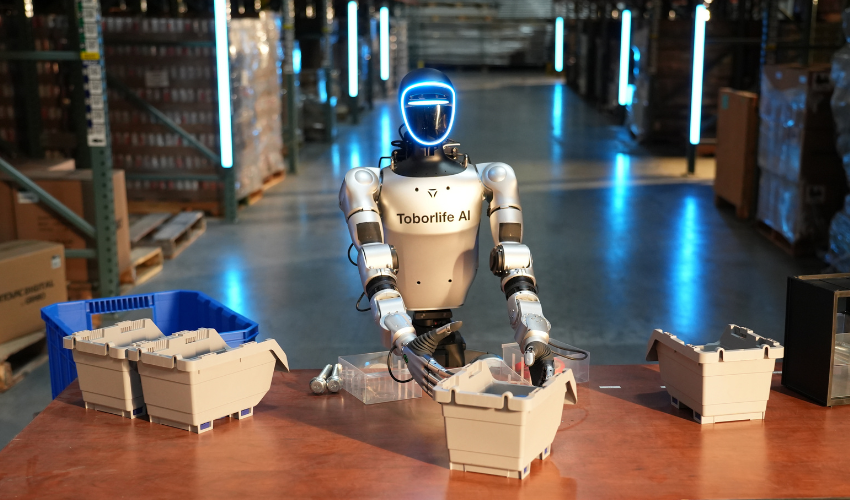
At Toborlife AI, that’s the core job of the Tobor Harness™ teleoperation system: an XR headset and motion tracking rig paired with whole-body control, built to capture that data directly from the G1 in a form a training pipeline can use. Tobor Harness generates the data that trains a model. It doesn’t run the model itself.
Build vs. Buy Unitree Teleoperation System
For a team doing serious robotic learning research, manual joystick control was never a real contender. The actual choice researchers face is between building a teleoperation rig from scratch or buying one that already works.
Building means sourcing tracking hardware, writing calibration and synchronization software, and validating that the captured data is clean enough to train on. Teams that go this route typically report months of development before they collect their first usable dataset, and that’s before any policy training starts.
Buying a unitree teleoperation system compresses that timeline to setup and calibration on hardware that’s already been validated against the G1 platform.
Getting Set Up With Teleoperation
If you’re searching for unitree teleoperation services, what you’re usually looking for is help getting a working system running on your G1 without burning a quarter on integration work.
Toborlife AI sells Tobor Harness as a complete system: a team gets the hardware and software to run their own teleoperation and data collection. Toborlife also works with teams during setup and provides after-sales support once the system is running, so getting from unboxed hardware to a working data pipeline doesn’t fall entirely on one engineer’s spare time.
Start Collecting Data Your G1 Can Actually Learn From
Teleoperation is the method that makes robots smarter. Every viral demo clip started as teleoperated data before it became a trained skill.
If your G1 is sitting on basic operation and you’re ready to move toward real training data, talk to a robotics expert about getting a Tobor Harness system set up.

Comments are closed for this post.