A Concert Moment That Felt Like A System Test
From a distance, the clip looks entertaining. Look closer and it feels technical.
Six humanoid robots moved together with timing that had little margin for error. Stage lighting changes fast. Music beats shift. Human dancers adjust their steps in real time. For a robot, this is a demanding environment.
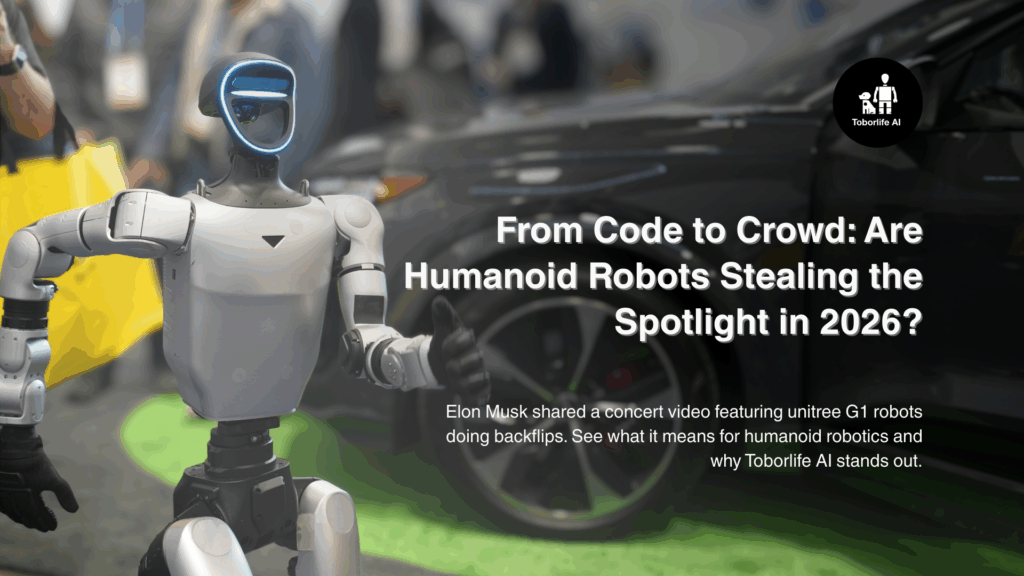
Each Unitree G1 had to maintain balance on a hard stage surface. Each robot had to execute pre-planned motion sequences while reacting to small changes around it. The backflips alone require precise torque control, joint timing, and recovery stability. One misstep could end the show.
Yet the robots landed cleanly.
This tells us something important. Humanoid robots are crossing a line from careful motion to expressive motion. That is a big deal in robotics.
Why Backflips Expose Real Technical Progress
A backflip is not just a trick. In robotics, it is a stress test.
To flip safely, a humanoid robot must coordinate dozens of motors in milliseconds. It must predict its center of mass while airborne. It must land and stabilize instantly without human help.
This requires:
- High speed joint actuators
- Real time motion planning
- Advanced balance algorithms
- Accurate sensor feedback
The unitree G1 platform uses depth cameras and LiDAR to understand space. It relies on dynamic control systems that adjust movement continuously. These systems were once limited to research labs. Now they are performing live under stage lights.
That shift marks a clear step forward.
From Lab Demos To Public Environments
Until recently, humanoid robots mostly appeared in controlled settings. Tech expos. Factory floors. Research videos with multiple takes.
A live concert is different.
There is no pause button. There is no second take. The robots must perform alongside humans and adapt to timing cues. This shows confidence in both hardware and software.
Observers also compared this moment to robot performances at earlier national events in China. Those robots moved cautiously. The difference in agility today is clear.
The progress curve is steep.
The Price Point That Changes The Conversation
One reason the video caused so much discussion is cost.
The G1 platform is priced far below most humanoid robots shown by Western companies. Reports place it in the low five-figure USD range depending on configuration. That is still expensive. But it is no longer unreachable for universities, labs, and innovation-focused companies. This is where unitree G1 Edu becomes relevant.
Education focused humanoid robots are no longer passive teaching aids. They are active research platforms. Students can test locomotion algorithms. Developers can train motion models. Startups can prototype applications without waiting years.
Access changes innovation speed.
Why Elon Musk’s Reaction Amplified Everything
Musk did not add any analysis. He did not write a long thread. He simply called it impressive.
That single word mattered.
As the CEO of Tesla, which develops its own humanoid robot, his reaction was seen as recognition of progress outside his ecosystem. It also showed how competitive and fast moving humanoid space has become.
Global attention followed. Media coverage expanded beyond robotics circles. The conversation shifted from novelty to capability.
This is exactly how technology adoption starts.
Entertainment Is Not The End Goal
Robots dancing on stage is not the future use case. It is a signal.
If a humanoid robot can perform synchronized acrobatics in public, it can likely handle other complex tasks. Navigation in crowded spaces. Coordinated work with humans. Precision movement under unpredictable conditions.
These capabilities translate into:
- Training simulations
- Event engagement
- Research and testing
- Interactive public installations
Entertainment is the gateway, not the destination.
Where Toborlife AI Fits Into This Shift
At Toborlife AI, we focus on access and application. Our goal is not to chase viral moments. It is to help builders, educators, and businesses work with real humanoid systems today.
The rise of platforms like G1 proves that demand is growing. People want robots they can test, program, and deploy. Not just watch.
Toborlife AI features advanced humanoid platforms like the Unitree G1, giving customers direct access to a robot already proven in public performance and technical demonstrations. With agile motion control, advanced sensing, and a compact humanoid form, the G1 fits research labs, education programs, and early-stage deployment projects.
Toborlife AI curates humanoid and service robots with a clear focus on:
Practical deployment
Robots selected for real use cases, not just demos or concept showcases.
Transparent specifications
Clear performance data so buyers know exactly what each system can handle.
Global shipping support
Reliable logistics and documentation to serve customers worldwide.
Education and enterprise readiness
Platforms suited for classrooms, labs, startups, and business environments.
Scalable upgrade paths
Systems that support future software, hardware, and capability expansion.
Technical Progress Is Accelerating In Public View
What makes 2026 different is visibility.
Robots are no longer hidden behind research papers. They are on stage, in malls, at events, in classrooms, etc. Each public appearance builds familiarity and trust.
The G1 concert performance is one moment in a larger trend. Humanoid robots are becoming part of daily visual culture. That shapes acceptance faster than white papers ever could.
For developers and institutions, this is the time to engage. Waiting means falling behind a fast curve.
Should You Be Paying Attention Now?
If you work in robotics, education, or tech driven business, the answer is yes.
Humanoid platforms are reaching a point where experimentation makes sense. Prices are dropping. Capability is rising. Public proof points are appearing.
The concert video was entertaining. But the real story is underneath. Control systems are improving. Motion planning is maturing. Human robot interaction is becoming natural.
That is not future talk. That is now.
Explore Humanoid Robots With Toborlife AI
If this moment made you curious, take the next step. Visit toborlife.ai to explore humanoid robots and advanced platforms designed for learning, testing, and deployment.
We help you compare systems. We explain strengths clearly. We support your journey from interest to action.
If you have questions or want guidance on choosing the right platform, our team is ready to help.
The robots are ready for the stage. The question is simple.
Are you ready to work with them in 2026?

Comments are closed for this post.