Unitree G1 in Hospitality
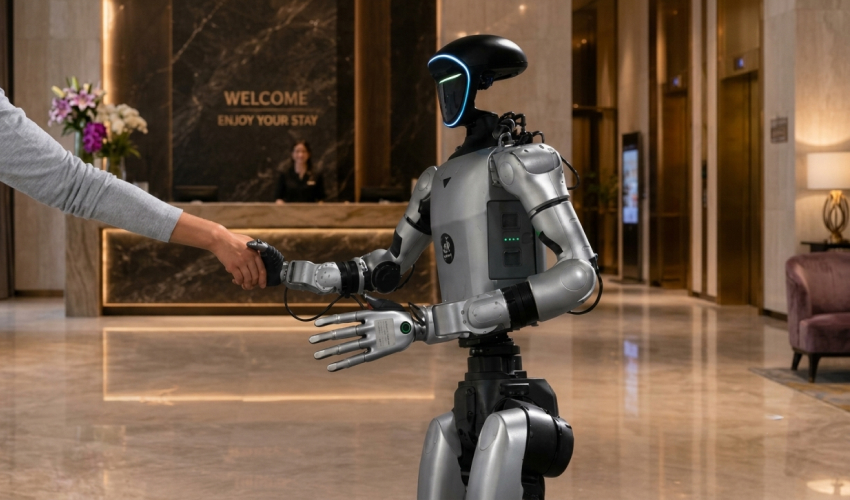
Hospitality depends heavily on customer interaction and repetitive service workflows, which makes it one of the most visible environments for interactive robotics.
Guest reception. Out of the box, a G1 base model can greet visitors and hold basic conversation using a ChatGPT-based voice interaction, accessible through the Unitree app. That’s simple human-to-robot small talk, not a concierge desk — the base voice layer isn’t connected to a hotel’s booking system or the internet, so it can’t answer a guest’s specific question about room locations or tonight’s dinner reservation on its own.
Getting to real reception and wayfinding functionality, like answering facility-specific questions or pointing a guest to a conference room, takes custom development on top of that base voice layer. The G1 Edu carries a second onboard Nvidia compute module left open for exactly this: an SDK developers can build on directly, without touching the robot’s core control system. That’s the opening for a hospitality team to build toward something closer to a trained receptionist, connected to its own systems instead of Unitree’s default assistant.
Delivery and service. The G1’s arms and hands open up delivery and service tasks, such as carrying room-service items, opening doors for customers, or handling light objects along the way. General-purpose manipulation like this is still in early-stage development, but it’s a common deployment goal within the robotics industry, with many anticipating prototype launches within the next few years.
Events and experiences. At conferences and exhibitions, robots can greet attendees, demonstrate technology, or serve as an attraction. The G1 ships with a library of pre-programmed motions, including dances, a wave, handshake, high wave, clap, hand kiss, X-ray pose, and X sign, that users can trigger directly from the included joystick controller.
Through a demo teaching function built into the Unitree app, users can also move and position the G1’s arms directly to build custom poses beyond the preset library. That opens up more customizable action for clients to use during events and create meaningful experiences for their audiences. See demo teaching mode in action: Toborlife’s G1 customized dance.
Unitree Robots in Healthcare
Healthcare, as a highly regulated industry, requires significant human expertise. At this stage, most robotics applications in healthcare focus on assistance, logistics, and research rather than replacing clinical professionals.
Hospital logistics. Robots can take over tedious, repetitive transportation tasks, including moving supplies, equipment, or samples between departments. This streamlines transportation and frees healthcare workers to spend more time on patient care. As robots get better at navigating complex indoor environments, these applications become more practical.
Patient interaction. A humanoid robot could help provide reminders, answer basic questions, or guide patients through facilities. More physically interactive assistance is a long-term direction for the industry, but any role involving decision support would need far more reliability, safety validation, and clinical oversight than logistics work does; that bar hasn’t been cleared yet. At the moment, the opportunity is to use robots for tasks that are repetitive and structured, while humans stay responsible for decisions requiring empathy and medical judgment.
Research and rehabilitation. Robots can perform repeatable physical exercises, assist researchers studying human movement, or serve as a development platform for perception, manipulation, and teleoperation research in surgical environments.
Unitree G1 Edu in Education
Education may be the most flexible environment for interactive robotics because robots function as teaching tools, research platforms, and technology demonstrations at once. This is where the Unitree G1 Edu line was built to fit.
STEM instruction. The Unitree G1 gives students a physical platform for learning programming, computer vision, and control systems, and lets them test their code on real hardware. The Unitree G1 Edu and R1 give university programs an accessible, development-ready humanoid platform, so departments don’t need to build one from scratch. Its secondary development support and dedicated onboard compute let students go beyond the base G1’s joystick control and preset motions to build and run their own code directly on the robot.
Research platforms. Beyond the classroom, faculty and graduate researchers use that same onboard computer to investigate open problems: manipulation, reinforcement learning, and human-robot interaction. Teleoperation is particularly valuable here. Researchers teleoperate the robot to collect robot-centric data, then process and train on it as part of the sim-to-real pipelines used for policy development.
The Next Stage
Hospitality, healthcare, and education are still early in figuring out where interactive robots fit. Guest greetings, hospital logistics, and classroom demos are the use cases in production today. Custom manipulation, decision support, and more autonomous behavior are still ahead, coming into focus as the G1 Edu’s development tools and teleoperation-driven data collection mature.
That gap between what’s possible now and what’s coming is where the opportunity sits. Organizations building experience with the G1 today, through demos, pilots, and custom development, are the ones positioned to move fast as that gap closes.
Bring Interactive Robotics to Your Organization
At Toborlife AI, we pair the Unitree G1 with our Tobor Harness™ System to help hospitality, healthcare, and education teams explore what interactive robotics can do in their own environment — from guest-facing demonstrations to full-body teleoperated data collection for robot learning.
Exploring what a Unitree G1 could do for your organization? Talk to a Robotics Expert .

Comments are closed for this post.