Google’s Intrinsic Project Moves Into the Center of the AI Strategy
For years, Intrinsic existed inside Alphabet’s “Other Bets” division. These were experimental projects designed to test ambitious ideas.
Intrinsic was created to solve a major robotics challenge. Robots are powerful machines but programming them is extremely complex. Each robot requires specialized code for tasks, sensors, and environments.
Intrinsic’s mission was to simplify that process.
The project focuses on building an operating system layer for robots. Many people describe it as the “Android of robotics.” Developers can create applications that work across different robots and hardware systems.
Google’s decision to bring Intrinsic directly into its main organization signals a new direction. Robotics is no longer a distant moonshot. It is becoming part of Google’s core AI strategy.
The company plans to combine several technologies:
- advanced AI models from DeepMind
- cloud computing infrastructure
- robotics development tools
- machine learning systems that understand physical environments
This combination forms the foundation of physical AI.
Physical AI Is the Next Stage of Artificial Intelligence
For decades, AI systems lived mostly inside computers. They analyzed data, generated text, or helped with search results.
Physical AI changes that idea. Instead of only processing information, AI systems begin to act in the real world through machines.
Think about a robot that can:
- recognize objects in a room
- move safely around people
- pick up tools or packages
- adapt its actions as conditions change
This type of AI requires several layers of technology working together.
First comes perception. Robots must understand their surroundings using cameras, sensors, and spatial mapping. Second is reasoning. AI systems decide what action to take based on goals and environmental data. Third is motion control. Robots must convert decisions into precise movements.
Google’s Intrinsic platform focuses heavily on the software layer that connects these capabilities.
Why Humanoid Robots Are Becoming the Ideal Platform for Physical AI
Factories often use specialized robotic arms. Those machines perform repetitive tasks extremely well.
Humanoid robots serve a different purpose.
They are designed to operate in environments made for humans. That means stairs, doors, tables, and tools. Instead of redesigning infrastructure for robots, humanoid machines adapt to existing spaces.
This approach opens many new applications:
- logistics facilities
- research labs
- warehouses
- customer service environments
- inspection and monitoring tasks
Humanoid robots can navigate areas where traditional industrial robots struggle. This is why many robotics companies are investing heavily in humanoid platforms.
The Rise of the Unitree G1 Platform
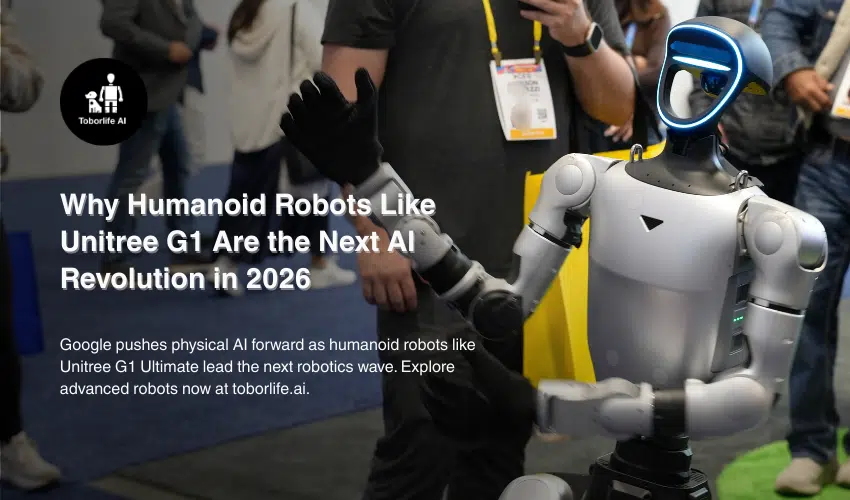
Among the robots gaining attention in the industry is the Unitree G1.
This humanoid robot represents a new generation of robotic systems designed for agility and research development.
The Unitree G1 Ultimate version showcases the highest level of capability within the G1 lineup.
The robot includes advanced features such as:
- dynamic balance control for stable walking
- high torque electric actuators for joint motion
- integrated sensors for environmental awareness
- modular design for research and AI development
These features allow developers and researchers to experiment with physical AI applications in real environments. Humanoid robots like the G1 provide a platform where AI software can interact with the physical world.
That is exactly the kind of system needed for the next generation of AI.
Why Robotics Is Becoming a Core Technology for the AI Industry
The AI boom over the past decade focused on digital tools. Language models, search systems, and automation software. Now the industry is expanding into the physical world.
Several trends are pushing robotics forward. Together, these developments are creating the foundation for widespread robotics deployment.

Comments are closed for this post.