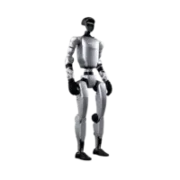
Unitree G1 Teleoperation Is More Than Unitree G1 Remote Control
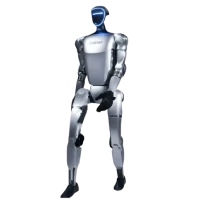
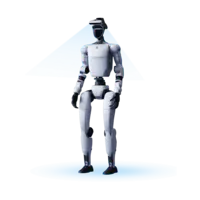
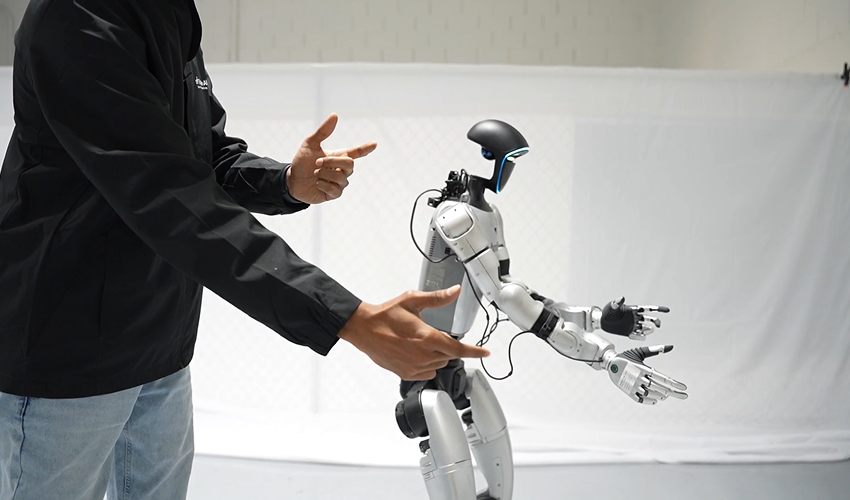
A developer wearing an XR headset can see through the robot’s cameras, control its movements naturally using body tracking, manipulate objects with dexterous hands, and record every action performed.
Those demonstrations don’t just move the robot—they become valuable training data for future autonomy.
For robotics companies pursuing embodied AI, teleoperation is no longer simply a control method. It is the foundation for collecting the high-quality demonstration data needed to train autonomous robot behavior.
Three Approaches to Unitree G1 Teleoperation
Today, there are three common approaches to controlling a Unitree G1, each serving different development needs.
1. Basic Remote Control
The simplest option uses a handheld controller or Unitree’s in-app software interface.
This works well for:
- Robot demonstrations
- Mobility testing
- Basic locomotion
It’s quick to set up and ideal for simple movement, but it becomes difficult when tasks require coordinated whole-body motion or precise manipulation.
For developers working on dexterous tasks or AI training, basic remote control is often only the first step.
2. Open-Source Unitree XR Teleoperation
To support robotics research, Unitree provides XR Teleoperate, an open-source teleoperation framework supporting devices such as Apple Vision Pro, Meta Quest, and PICO headsets. The framework enables immersive robot control, supports multiple humanoid platforms and dexterous hands, and includes recording capabilities for robotics research workflows.
For experienced robotics teams, this flexibility is a major advantage.
Developers can customize the software, integrate it into their own research pipeline, and experiment with different control strategies.
The tradeoff is complexity. Deploying an open-source framework typically requires configuring multiple repositories, networking, certificates, camera services, XR devices, and robot communication libraries before teleoperation can begin.
For research labs with dedicated resources, this approach offers maximum flexibility. However, for organizations focused on deploying robots or scaling development, assembling and maintaining the entire stack requires significant engineering effort.
3. Integrated Teleoperation Platforms
A growing number of robotics organizations are moving beyond standalone teleoperation tools toward complete development platforms.
Rather than viewing teleoperation as the final goal, these platforms treat it as the beginning of an embodied AI workflow.
The objective is not simply to control the robot, but to capture demonstrations, build datasets, train policies, and deploy increasingly capable autonomous behaviors.
From Teleoperation to Embodied AI
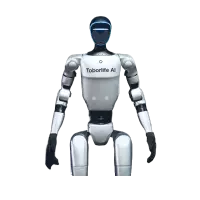
One example is the Tobor Harness™ Teleoperation System. Rather than focusing solely on robot control, Tobor Harness was designed as a complete Unitree G1 teleoperation kit that integrates directly with Toborverse, Toborlife AI’s proprietary data collection and model training ecosystem.
A typical workflow looks like this:
- Control the Unitree G1 using Tobor Harness full-body XR teleoperation.
- Coordinate stable movement through a proprietary Whole Body Controller (WBC).
- Capture synchronized demonstrations during every teleoperation session.
- Organize, label, and clean datasets within Toborverse.
- Train and fine-tune robot policies using curated demonstration data.
- Deploy updated models back to the robot and continue improving performance.
Rather than stitching together multiple tools and pipelines, robotics teams can manage the complete development lifecycle within a single ecosystem. This reduces engineering overhead while creating a repeatable workflow for robotics development.
What Makes Tobor Harness™ Different?
While both open-source frameworks and integrated platforms enable XR teleoperation, they are designed with different priorities.
Open-source frameworks prioritize flexibility and customization.
Tobor Harness prioritizes a complete, efficient embodied AI workflow.
Key capabilities include:
- Full-body XR teleoperation for natural robot control
- A proprietary Whole Body Control system for coordinated arms, torso, balance, and locomotion
- Dexterous hand control supporting BrainCo Revo 2 and Unitree Dex3 hands
- Stereo robot vision streamed directly into the XR headset
- Integrated technical deployment and support
- Native integration with Toborverse for AI data collection, dataset management, policy training, and deployment
Why Data Collection Matters
For many robotics teams, the most valuable outcome of teleoperation isn’t the demonstration itself, but the data.
Every successful demonstration represents an example of how a robot should perform a task.
With Toborverse, those demonstrations become structured assets that can be reviewed, grouped, cleaned, labeled, and used to train future robot policies.
This transforms teleoperation from a remote control tool into a repeatable robotics development process.
Choosing the Right Platform
The best teleoperation solution depends on your goals.
If you’re experimenting with robot control or developing custom research software, an open-source framework may provide the flexibility you need.
If your objective is to accelerate embodied AI development through an integrated workflow that connects teleoperation, proprietary robot control, AI-ready data collection, policy training, and deployment, a complete platform can significantly reduce development complexity.
As humanoid robots become more capable, teleoperation will continue to play an essential role. The future of robotics will be built by the teams that can efficiently transform human demonstrations into intelligent autonomous behavior.


Comments are closed for this post.