The Coffee Chat That Started It All
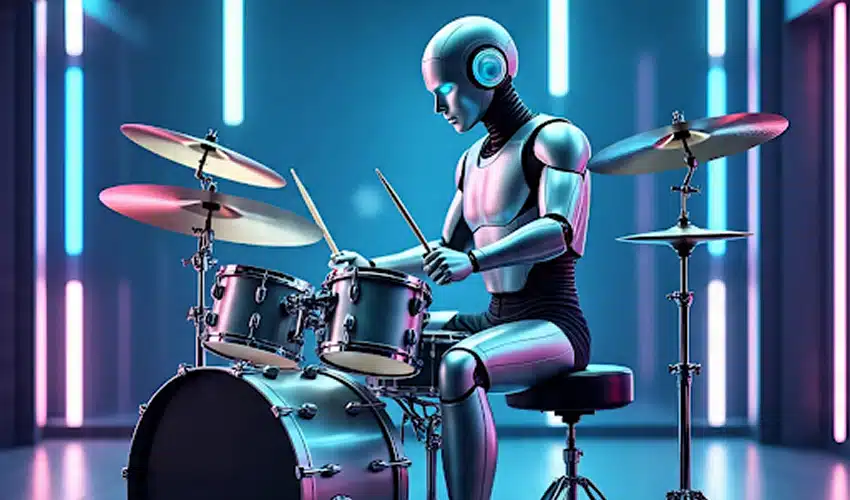
The idea was born during a casual conversation between researchers Asad Ali Shahid and Loris Roveda. They were discussing humanoid robots in creative fields and landed on drumming as a test case.
Why drumming? Because it requires rhythm, timing, coordination, and improvisation. All skills thought to belong firmly in the human domain.
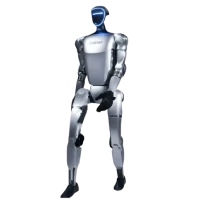
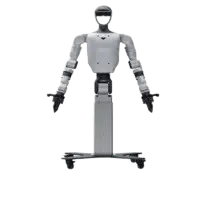
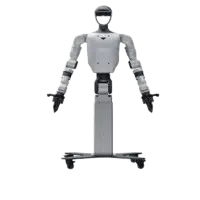
By choosing the Unitree G1, a humanoid platform, they had a canvas ready to learn one of the hardest performing arts. The project quickly grew beyond a fun experiment, becoming a benchmark for what humanoid robots might achieve in creativity.
How the Robot Drummer Works
Turning music into robotic drumming required more than just programming beats. The researchers developed a structured process to give the humanoid robot clear, repeatable instructions without losing rhythm.
- Translation system: Songs were converted into what they described as a “rhythmic contact chain.” This broke down each note, pause, and accent into specific movement commands for the robot’s arms and sticks.
- Motor control: Advanced motor coordination ensured the robot struck drums at precise points and angles, handling repetitive hits while smoothly switching between instruments.
- Technique replication: Human drummers rely on techniques like stick switching and crossing arms to manage fast or complex passages. These were modeled and integrated into the robot’s algorithms.
- Simulation training: Before touching real drums, the robot practiced in a virtual environment. Engineers refined timing, adjusted striking force, and corrected movement flow until the patterns sounded natural.
Once perfected in simulation, the algorithms were transferred to the physical Unitree G1 robot. The results were staggering. It achieved over 90% timing accuracy, even when performing tracks with irregular time signatures or rapid tempo shifts.
Songs and Styles It Mastered
Researchers tested the robot across multiple genres to measure adaptability:
- Rock: It executed the heavy beats and transitions of “In the End” by Linkin Park with accuracy and consistency.
- Jazz: Dave Brubeck’s “Take Five” challenged the robot with its unusual 5/4 time signature, yet it adapted smoothly.
- Metal: Fast double-time patterns demonstrated its ability to maintain stamina under high speed.
- Pop: Clean, steady rhythms showed precision in mainstream styles.
- Fusion: Complex mixes of tempo and rhythm shifts highlighted its flexibility.
The combination of genres proved the robot was not limited to one style. In all cases, it balanced strict precision with a surprisingly natural flow. The most impressive feat was speed: the robot sustained 200 beats per minute without losing consistency—a demanding level even for professional human drummers.
The Bigger Picture of Rhythm and Robotics
The breakthrough is more than a novelty. It shows how robotics is reaching a new stage of maturity. This opens doors not only for music but for other fields where rhythm, precision, and adaptive control are essential. For example, surgical robots, industrial assembly arms, and even automated performers in entertainment could use similar systems.
By learning to replicate such a human-centered skill, the robot demonstrates:
- Fine motor mastery: It can handle microsecond-level timing decisions.
- Adaptive performance: The system shifts between different rhythms without resetting or breaking pace.
- Artistic integration: Instead of looking mechanical, the performance felt fluid and musical.
The Role of Unitree in Advancing Robotics
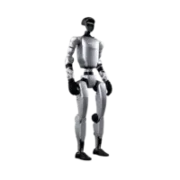
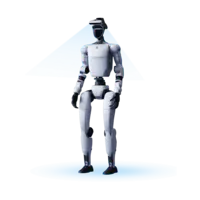
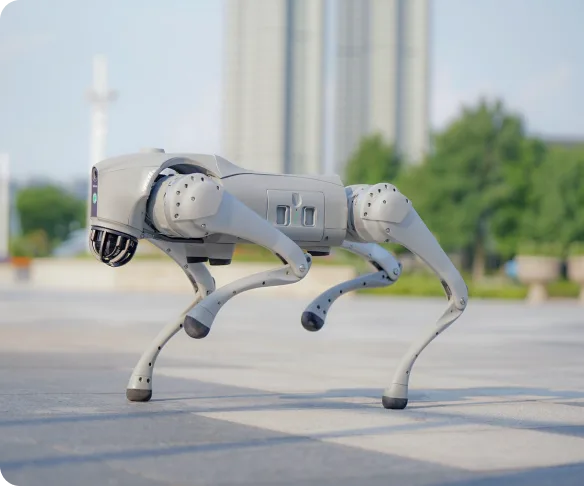
At the center of this achievement was the Unitree G1 robot, a humanoid platform designed for flexibility, stability, and high-speed motion. Unitree has been known for building robots that move with surprising agility. By combining those capabilities with advanced AI for rhythm and timing, researchers pushed the limits of what a humanoid robot can express.
While the spotlight is on the drummer for now, the larger story is how robotics companies like Unitree are setting new benchmarks.
This raises the question: who will take these breakthroughs and turn them into everyday products?
Why Does Toborlife Leads The Way in Modern Robotics?
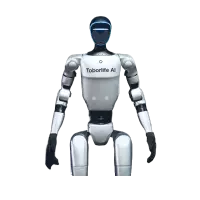
At Toborlife AI, we see this moment as more than entertainment. It’s proof that humanoid robots can connect technical skill with human-like expression. That’s exactly what our own products are designed to achieve: innovative, more affordable, and more versatile robotics for real-world use.
While Unitree’s experiment shows what’s possible, Toborlife focuses on making robotics practical for homes and businesses. From AI-powered companions to automated workforce solutions, we’re building the tools to bring futuristic technology into daily life.
What Comes Next?
Will robotic musicians tour with bands in the near future? Could robots replace or assist human performers at large events?
These questions are no longer theoretical. With precision at 200 beats per minute and the ability to adapt across genres, humanoid robots are already demonstrating capabilities that seemed far-fetched a decade ago.
For Toborlife AI, the next step is clear: to make these technologies accessible, practical, and valuable for everyday users. If a robot can master Take Five or hold tempo at 200 BPM, imagine what it can do for security, logistics, or customer interaction.
Final Thoughts
A humanoid robot drummer has proven that machines can go beyond mechanics to touch something closer to art. This is more than a story about beats and rhythms. It’s a glimpse into a future where robots are not just tools but performers, collaborators, and partners in creativity.
If you’re curious about what robotics can do for your world, now is the time to explore.
Visit Toborlife AI today and see how our products are shaping the future of intelligent automation!


Comments are closed for this post.