Toborlife AI Robots
Applications arrow-icon
Teleoperation Home Business Education & Research Police & Fire Safety
Media arrow-icon
Robot News Toborlife Event Robot Blogs
Resource Center
Win a Robot

(408) 409-4061 Talk to an Expert
  • Go2 Pro & Edu
  • Go2 Ent
  • Go2-W
  • A2
  • B2
Homedog Pro

Homedog (Go2 Pro)

$3,790

  • Base Model
Go2 Edu Standard

Go2 Edu Standard

$11,190

  • 40 TOPS Secondary Dev
Go2 Edu Plus

Go2 Edu Plus

$13,205

  • Realsense D435i depth camera
  • 100 TOPS Secondary Dev
  • Optional servo arm
Go2 Edu Mid-360

Go2 Edu Mid-360

$17,055

  • Mid-360 LiDAR
  • 100 TOPS Secondary Dev
  • Optional servo arm
Go2 Edu Hesai XT16

Go2 Edu Hesai XT16

$19,430

  • LiDAR Hesai XT16
  • 100 TOPS Secondary Dev
  • Optional servo arm
Go2-X

Go2 X

$7,600

  • 1×LiDAR & HD camera
  • Optional GPS + 4G included

Shop All Go2 Edu Models arrow-icon

Go2 Ent

Go2 Ent

$13,205

  • Dual communication
  • Standard image sensing
Go2 Ent Plus

Go2 Ent Plus

$17,005

  • Searchlight
  • Police warning lights (red/blue)
Go2 Ent MPTZ

Go2 Ent MPTZ

$22,705

  • Thermal imaging sensor
  • Full 3-axis gimbal stabilization
Go2 Ent GAS

Go2 Ent GAS

$11,305

  • Industrial gas sensors
  • Ethernet & 458 industrial interface
  • Temperature measurement
Go2-W Ent-Plus

Go2-W Ent-Plus

$17,999

  • Realsense D435i depth camera
  • 3D LiDAR (Mid-360/Hesai XT16)
  • Optional servo arm
Go2-W Ent-U2

Go2-W Ent-U2

$23,999

  • Realsense D435i depth camera
  • 3D LiDAR (Mid-360/Hesai XT16)
  • Optional servo arm
Go2-W Standard

Go2-W Standard

$13,000

  • Realsense D435i depth camera
  • Optional servo arm
  • 40 TOPS Secondary Dev
Go2-W Plus

Go2-W Plus

$15,199

  • Realsense D435i depth camera
  • Optional servo arm
  • 100 TOPS Secondary Dev
Go2-W Smart

Go2-W Smart

$18,905

  • Depth camera + Mid-360
  • Optional servo arm
  • 100 TOPS Secondary Dev
Go2-W Ultimate

Go2-W Ultimate

$20,890

  • Depth camera + Hesai XT16
  • Optional servo arm
  • 100 TOPS Secondary Dev
Go2-W Inspection

Go2-W Inspection

$32,299

  • Depth camera + Hesai XT16
  • Thermal imaging sensor
  • Hardware platform only
A2

A2

Deposit at$990

  • 1×LiDAR & HD camera
  • Optional GPS + 4G included
A2 Pro

A2 Pro

Deposit at$990

  • 2×LiDAR & HD camera
  • GPS + 4G included
  • High compute expansion dock
A2-W

A2-W

Deposit at$990

  • 1×LiDAR & HD camera
  • Optional GPS + 4G included
A2-W Pro

A2-W Pro

Deposit at$990

  • 2×LiDAR & HD camera
  • GPS + 4G included
  • High compute expansion dock
B2

B2

$85,900

  • Up to 40 kg moving load
  • Climbs 40 cm forward steps
B2-W

B2-W

$97,600

  • Up to 240 kg moving load
  • Climbs 16 cm forward steps
Get Accessories
Go2 Go2 Edu Go2-Ent Go2-W A2 B2 B2-W
  • G1
  • G1-D
  • R1
  • H2
Unitree G1 Basic Robot

G1 Basic

$21,600

  • Dummy hands
  • 23 Degrees of freedom
G1 Edu Standard

G1 Edu Standard

$43,900

  • Dummy hands
  • 23 Degrees of freedom
  • 100 TOPS Secondary Dev
G1 Edu Plus

G1 Edu Plus

$53,900

  • Dummy hands
  • 29 Degrees of freedom
  • 100 TOPS Secondary Dev
G1 Edu Pro B

G1 Edu Pro A/B

$56,900

  • Tactile Dex3-1 3-Finger hands
  • 37 Degrees of Freedom
  • 100 TOPS Secondary Dev
G1 Edu Pro F

G1 Edu Pro E/F

$56,900

  • Tactile BrainCo 5-Finger hands
  • 35 Degrees of Freedom
  • 100 TOPS Secondary Dev
G1 Edu Ultimate B

G1 Edu Ultimate A/B

$67,900

  • Tactile Dex3-1 3-Finger hands
  • 43 Degrees of Freedom
  • 100 TOPS Secondary Dev
G1 Edu Ultimate D

G1 Edu Ultimate C/D

$73,900

  • Tactile Inspire 5-finger hands
  • 41 Degrees of Freedom
  • 100 TOPS Secondary Dev
G1 Edu Ultimate F

G1 Edu Ultimate E/F

$67,900

  • Tactile BrainCo 5-Finger hands
  • 41 Degrees of Freedom
  • 100 TOPS Secondary Dev
G1 Comp Athletic Robotic Humanoid

G1 Comp Athletic Robotic Humanoid

$48,900

Shop All G1 Models arrow-icon

G1-D Standard A

G1-D Standard A

$38,800

  • Dex1-1 2-Finger grippers
  • 19 Degrees of Freedom
G1-D Standard C

G1-D Standard B/C

$53,800

  • Tactile Dex3-1 3-Finger hands
  • 31 Degrees of Freedom
G1-D Standard E

G1-D Standard D/E

$53,800

  • Tactile BrainCo 5-Finger hands
  • 29 Degrees of Freedom
G1-D Ultimate A

G1-D Ultimate A

$51,900

  • Dex1-1 2-Finger grippers
  • 21 Degrees of Freedom
  • Mobile Chassis
G1-D Ultimate C

G1-D Ultimate B/C

$66,300

  • Tactile Dex3-1 3-Finger hands
  • 33 Degrees of Freedom
  • Mobile Chassis
G1-D Ultimate E

G1-D Ultimate D/E

$66,300

  • Tactile BrainCo 5-Finger hands
  • 31 Degrees of Freedom
  • Mobile Chassis

Shop All G1-D Models arrow-icon

R1 Basic

R1 Basic

$8,990

  • Dummy hands
  • 24 Degrees of Freedom
R1 Edu Standard

R1 Edu Standard

$15,950

  • Dummy hands
  • 24 Degrees of Freedom
  • 40 TOPS Secondary Dev
R1 Edu Smart

R1 Edu Smart

$18,900

  • Dummy hands
  • 26 Degrees of Freedom
  • 100 TOPS Secondary Dev
R1 Edu Pro B

R1 Edu Pro A/B

$32,900

  • Tactile Dex3-1 3-Finger hands
  • 40 Degrees of Freedom
  • 100 TOPS Secondary Dev
R1 Edu Pro D

R1 Edu Pro C/D

$32,900

  • Tactile BrainCo 5-Finger hands
  • 38 Degrees of Freedom
  • 100 TOPS Secondary Dev

Shop All R1 Models arrow-icon

H2

H2

Deposit at$2,500

  • Dummy hands
  • 31 Degrees of Freedom
H2 Edu

H2 Edu

Deposit at$2,500

  • Optional hands (various models)
  • 40 Degrees of Freedom
  • Jetson Thor / 300 TOPS

Shop All H2 Models arrow-icon

Get Accessories
G1 R1 H2
Toborlife AI Robots
Search
Phone Icon
cart-icon
  • No products in the cart.
View Cart
Subtotal: $0.00
    • Homedog Homedog (Go2 Pro)
      • Go2 Edu Go2 Edu Standard
      • Go2 Edu Plus Go2 Edu Plus
      • Go2 Edu Mid-360 Go2 Edu Mid-360
      • Go2 Edu Hesai XT16 Go2 Edu Hesai XT16
      • Go2 ent Go2 Ent
      • Go2 ent Go2 Ent Plus
      • Go2 ent Go2 Edu MPTZ
      • Go2 ent Go2 Ent GAS
      • Go2 ent Go2-W Ent-Plus
      • Go2 ent Go2-W Ent-U2
      • Go2-W Standard Go2-W Standard
      • Go2-W Plus Go2-W Plus
      • Go2-W Smart Go2-W Smart
      • Go2-W Ultimate Go2-W Ultimate
      • Go2-W Inspection Go2-W Inspection
      • A2 A2
      • A2 Pro A2 Pro
      • A2 W A2-W
      • A2 W Pro A2-W Pro
    • B2 EDU B2
    • B2-W B2-W
    • Get accessories for...
    • Homedog
    • Go2 Edu
    • Go2 Ent
    • Go2-W
    • B2
    • B2-W
      • G1 BasicAll G1 Models
      • G1 BasicG1 Basic
      • G1G1 Edu Standard
      • G1 EduG1 Edu Plus
      • G1 EduG1 Edu Pro A
      • G1 EduG1 Edu Pro B
      • G1 EduG1 Edu Pro E
      • G1 EduG1 Edu Pro F
      • G1 EduG1 Edu Ultimate A
      • G1 EduG1 Edu Ultimate B
      • G1 EduG1 Edu Ultimate C
      • G1 EduG1 Edu Ultimate D
      • G1 EduG1 Edu Ultimate E
      • G1 EduG1 Edu Ultimate F
      • R1G1-D Standard A
      • R1G1-D Standard B
      • R1G1-D Standard C
      • R1G1-D Standard D
      • R1G1-D Standard E
      • R1G1-D Ultimate A
      • R1G1-D Ultimate B
      • R1G1-D Ultimate C
      • R1G1-D Ultimate D
      • R1G1-D Ultimate E
      • R1R1 Basic
      • R1R1 Edu Standard
      • R1R1 Edu Smart
      • R1R1 Edu Pro A
      • R1R1 Edu Pro B
      • R1R1 Edu Pro C
      • R1R1 Edu Pro D
      • H1-2H2
      • H1-2H2 Edu
    • Get accessories for...
    • G1 Basic
    • G1 Edu
    • G1-D
    • H2
    • R1
  • Talk to an Expert
    • Teleoperation
    • Home
    • Business
    • Education & Research
    • Police & Fire Safety
    • Robot News
    • Robot Diaries
    • Robot Blogs
  • Enter to Win a Robot
  • Resource Center
  • About Us
  • Shipping
  • Returns and Exchanges
  • Warranty
  • Contact Us
Search
Clear
Tweet
teleoperation-robot

How Is a Teleoperation Robot Learning From Hands in 2026?

Toborlife AI June 15, 2026

The next major robotics breakthrough may not start with a robot walking across a factory floor. It may start with a human hand.

According to AP News, researchers at MIT have developed an ultrasound wristband that uses artificial intelligence to translate wrist images into real-time control of a dexterous robotic hand or manipulation in a virtual environment. That makes the teleoperation robot conversation much more practical for businesses watching the future of humanoid control interfaces.

The reason is simple.

Humanoid robots do not only need better legs, stronger motors, or more advanced processors. They need better ways to learn from humans. They need to understand how people move, grasp, reach, adjust, and interact with the physical world.

That is where hand-motion data becomes extremely important.

Discover how robots can better your life!

Discover Now

Why MIT’s Wristband Breakthrough Matters

MIT’s system captures movement from muscles, tendons, and ligaments beneath the skin. AP reported that the wristband uses high-frequency sound waves to “see” through the wearer’s skin, then relays those images to a computer where AI enables a robotic hand to mimic the gesture.

That sounds technical, but the business implication is clear.

Robots are getting better teachers.

For years, robotics companies have struggled with dexterity. A robot may be able to walk across a room, but manipulating objects with human-like precision is much harder. Picking up a cup, sorting tools, folding fabric, using a handle, or adjusting a small object requires high-resolution physical intelligence.

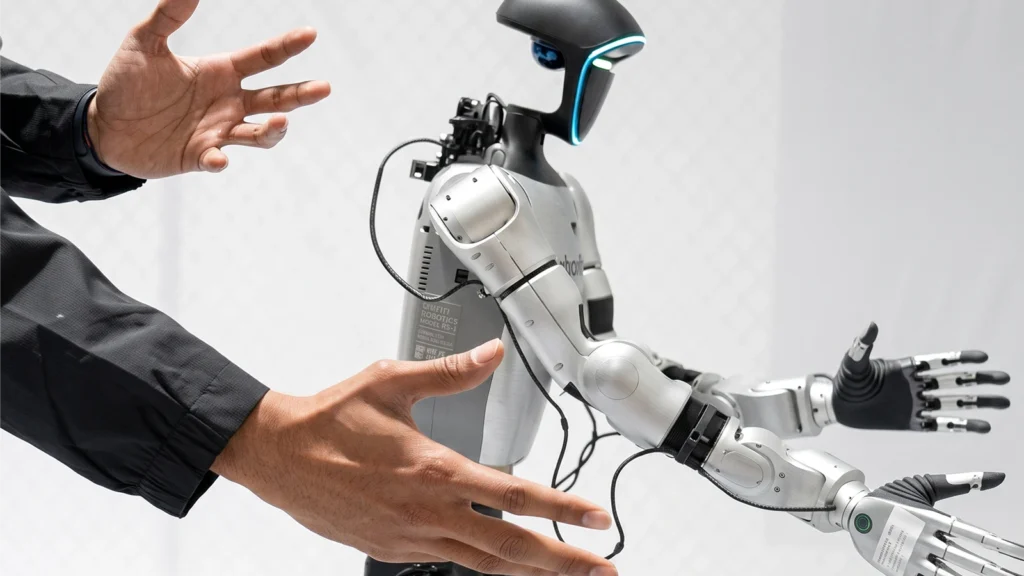
Human hands are extremely complex. AP noted that engineers describe hand movement through degrees of freedom, and the human hand has 22 of them. In lab demonstrations with eight volunteers, the MIT wristband precisely mirrored hand gestures, including all 26 letters in American Sign Language, within 120 milliseconds.

That type of responsiveness could eventually influence how humanoid robots learn fine motor skills.

The Bigger Shift: From Coding Robots to Teaching Robots

Traditional robotics workflows often required engineers to program specific actions manually. That approach works well for repetitive industrial automation, but it becomes difficult when robots must handle messy real-world environments.

The next wave of robotics is different.

Instead of only coding every instruction, teams are increasingly exploring ways for robots to learn from human demonstrations.

That includes:

  • Hand-motion tracking
  • XR-based movement capture
  • Remote operation
  • Video-based imitation learning
  • Sensor-rich teleoperation
  • Simulation-based training
  • Real-world demonstration datasets


This is why the idea of a
unitree teleoperation robot is gaining attention among businesses, developers, and research teams. Buyers are no longer asking only what a robot can do today. They are asking how easily a robot can become part of a learning workflow tomorrow.

Why Hands Are the Hardest Part of Humanoid Robotics

Humanoid robots are designed to operate in environments built for humans. That is what makes them so exciting.

Doors, shelves, tools, tables, machines, switches, handles, and workstations were all designed around the human body. If humanoids can eventually navigate those environments, they may support workflows without requiring companies to rebuild everything around automation.

But hand movement remains one of the hardest problems in humanoid robotics.

Walking toward a table is impressive. Picking up the right object is much harder. A robot needs to recognize the object, estimate its weight, choose the right grip, apply the right amount of force, and adjust instantly if the object shifts. A glass cup, a soft package, a slippery tool, and a fragile electronic part all require different handling strategies.

This is the frontier MIT’s work points toward. If robots can learn more accurately from human hand movement, they may eventually become better at tasks requiring dexterity, adaptation, and real-world judgment.

The future of humanoid robotics may depend heavily on high-quality physical data. The more accurately robots can learn from human movement, the faster they may improve in tasks requiring dexterity and adaptation.

Why Businesses Should Pay Attention Now

For many businesses, advanced robot learning may sound like a future research topic. But the trend is already becoming relevant for near-term planning.

Companies exploring humanoid robots today are often looking at use cases such as:

  • Product demonstrations: Humanoid robots can help companies turn abstract AI concepts into something customers, partners, and investors can see in real time.
  • Research and development: R&D teams can use humanoid platforms to test motion control, sensor integration, teleoperation workflows, and early physical AI applications.
  • Education and training: Schools, universities, and corporate training programs can use robots to teach coding, robotics engineering, AI interaction, and human-machine collaboration.
  • Brand activations: A humanoid robot can make a launch event, trade-show booth, or public campaign feel more futuristic, interactive, and memorable.
  • Robotics labs: Labs can use humanoid systems as hands-on platforms for testing new control methods, movement models, and robot learning frameworks.
  • AI experimentation: Teams exploring embodied AI can move beyond screen-based software and begin testing how AI systems behave in physical environments.
  • Human-robot interaction studies: Humanoid robots give researchers and businesses a way to study how people respond to robots in classrooms, events, workplaces, and public spaces.
  • Future workflow automation: Companies can use early humanoid deployments to understand which tasks may eventually benefit from robotic support or human-in-the-loop automation.


Even if fully autonomous humanoids are still evolving, human-in-the-loop control systems are becoming important stepping stones.

A business may not need a robot that can independently perform every task immediately. It may need a platform that can demonstrate interaction, collect data, support training, and help teams understand what physical AI can become.

This is where a unitree robot teleoperation strategy becomes valuable.

It allows organizations to think about humanoid robotics not only as a finished product, but as a platform for exploration.

Discover how robots can better your life!

See Details

Where XR Teleoperation Fits Into the Robotics Stack

Another major trend connected to MIT’s wristband work is XR control.

Unitree XR teleoperation points toward a broader movement in robotics: using extended reality tools to guide or train robots through natural human motion. Instead of controlling a robot only with buttons, joysticks, or scripts, future systems may use body movement, hand tracking, wearable sensors, cameras, and immersive interfaces.

This matters because robotics control needs to become more intuitive.

A future operator may not want to manually code every movement. They may want a more intuitive way to guide the robot, demonstrate a task, and let the system translate that human input into useful robotic behavior.

That could mean moving a hand and having the robot mirror the gesture, using an XR headset to guide the robot through a 3D environment, or recording human demonstrations that can later become training data. It could also involve supervising a humanoid remotely, switching between autonomous and human-guided control, or building task datasets that help the robot improve over time.

This direction is especially important for businesses that want practical control interfaces without needing to build a full robotics research team from scratch.

Toborlife AI and the Future of Buyer-Friendly Humanoid Robotics

As the control layer becomes more important, buyers need access to robotics platforms that can support experimentation, education, and real-world learning.

That is where Toborlife AI enters the conversation.

Toborlife AI provides access to Unitree-powered robot dogs and humanoid robots for customers exploring physical AI, robotic mobility, educational programs, events, and emerging automation workflows. For users interested in humanoid development, platforms such as the Unitree G1 Edu Pro B, G1 Edu Pro F, and G1-D models create a path into modern humanoid robotics.

That access matters because the robotics market is moving quickly.

Businesses are trying to understand which robot platform best fits their goals, especially as humanoid robotics expands across education, events, research, and early automation planning. A university may need a platform for coding and AI learning, while a corporate innovation team may need a robot that can create a strong live demonstration.

They also want to know how humanoid robots can support real-world demos, what role control interfaces may play, and whether teleoperation should become part of their future workflow. These questions matter because the market is moving beyond simple robot showcases and toward more practical human-in-the-loop systems.

For many teams, the bigger question is how physical AI can become part of their innovation strategy without requiring them to build everything internally. Toborlife AI helps users explore these questions through a buyer-facing robotics ecosystem, giving businesses a clearer path instead of forcing them to navigate the fast-moving robotics market alone.

Robot Training Data Is Becoming an Enterprise Asset

One of the biggest takeaways from MIT’s wristband research is that data is becoming a core robotics asset.

For software AI, training data usually comes from text, images, video, code, or digital behavior. For physical AI, the data is much more complex because the robot has to learn how actions work in the real world.

That data includes movement, force, balance, grip pressure, timing, spatial awareness, recovery behavior, human demonstrations, and sensor feedback. A robot does not only need to know what an object looks like. It needs to understand how heavy it feels, how it moves, how much pressure to apply, and how to recover when something shifts unexpectedly.

That is what makes robot training data harder to collect and far more valuable. It captures the relationship between intelligence and physical action, which is exactly what humanoid robotics needs to improve.

A humanoid robot that learns how to grasp, carry, sort, and interact may eventually depend on thousands or millions of high-quality demonstrations. Systems like MIT’s wristband suggest that future robot training pipelines may collect human motion data at much greater scale.

For businesses, this means robotics strategy may eventually include both hardware and data planning.

The question will not only be, “Which robot should we buy?”

It may also become, “How will this robot learn from our environment?”

Practical Applications Could Expand Quickly

The MIT breakthrough is still a research development, not a plug-and-play enterprise product. But the direction is important.

If human motion can be captured more easily and translated into robot control or training data, several fields could benefit:

  1. Healthcare and rehabilitation
    Robotic systems could eventually learn delicate hand movements for assistance or clinical support.
  2. Manufacturing and assembly
    Human demonstrations could train robots to handle complex, small-object workflows.
  3. Education
    Students could learn robotics through physical demonstration rather than only code.
  4. Retail and hospitality
    Humanoid robots may eventually perform more natural object interactions.
  5. Remote operations
    Operators could guide robots in environments where human presence is difficult or unsafe.
  6. Research labs
    Universities could collect higher-resolution movement data for physical AI studies.

For businesses exploring physical AI now, the lesson is clear: control interfaces will matter as much as robot hardware.

What This Means for Humanoid Buyers in 2026

Buyers should not interpret MIT’s breakthrough as a sign that every humanoid robot will instantly become fully dexterous.

That is not how robotics evolves.

The more useful takeaway is that the industry is building the missing layers required for better robot learning. Humanoid robots need stronger hardware, better AI models, richer sensor data, intuitive controls, and more human demonstrations.

Each of those layers is improving, which is why 2026 feels like a turning point for humanoid robotics.

Robots are not only becoming more autonomous. They are becoming easier to train, easier to supervise, and easier to connect with human workflows. That shift matters because businesses do not need to wait for perfect autonomy before they begin learning how physical AI could fit into their operations.

Early teams that explore humanoid platforms, teleoperation concepts, and robotics interfaces now will be better prepared as the technology matures. They will understand the hardware, the control systems, the limitations, and the practical use cases before the market becomes more crowded.

Final Thoughts

MIT’s ultrasound wristband breakthrough shows where robotics training may be heading. The future of humanoid control may depend less on rigid programming and more on capturing how humans naturally move through the world.

That shift could reshape robotics education, business demos, research environments, and future automation systems.

As physical AI continues moving from screens into real environments, Toborlife AI is helping businesses, developers, educators, and innovators explore the platforms that make this future tangible. To learn more about Unitree-powered humanoid robots, visit Toborlife AI or contact the Toborlife AI team for guidance on the best robotics platform for your goals.

Ready to make this robot yours?

Shop Now
  • Share:

Comments are closed for this post.

Search

Recent News

  • Why Is Unitree G1 Teleoperation Going Mainstream in 2026?
    June 16, 2026
  • Why Is Unitree Humanoid Teleoperation Rising in 2026?
    June 15, 2026
  • How Is a Teleoperation Robot Learning From Hands in 2026?
    June 15, 2026
  • How China’s $1B Robot Grid Bet Could Change 2026?
    June 11, 2026
  • Unitree G1 vs. Unitree H2 Robot: Which Humanoid Platform Leads in 2026?
    June 10, 2026

Archive

  • June 2026 6
  • May 2026 11
  • April 2026 10
  • March 2026 14
  • February 2026 11
  • January 2026 12
  • December 2025 14
  • November 2025 12
  • October 2025 14
  • September 2025 13
  • August 2025 13
  • July 2025 12
  • June 2025 8
  • May 2025 11
  • April 2025 8
  • March 2025 7
  • February 2025 9
  • January 2025 3

Contact Us

Call 408-409-4061 or fill out the form

Floating Contact Form

"*" indicates required fields

This field is for validation purposes and should be left unchanged.
footer-logo
  • instagram
  • Tiktok
  • Facebook
  • X
  • Linkedin
  • Linkedin

LET US HELP YOU

  • Shipping
  • Return & Exchanges
  • Cancel an Order
  • Warranty
  • Payment Information
  • Contact Us

GET TO KNOW US

  • About Us
  • Terms and Conditions
  • Privacy Policy

COMMUNITY

  • Robot News
  • Toborlife Event
  • Book Us for Events
  • Join Our Affiliate Program
All Rights Reserved © 2026.
We are a robotics company based in Mountain View, California, specializing in physical AI and advanced robotic systems. We are not affiliated with similarly named software or SaaS companies.
Scroll to top
TOBoRLife

Can Navigate Rough Terrain

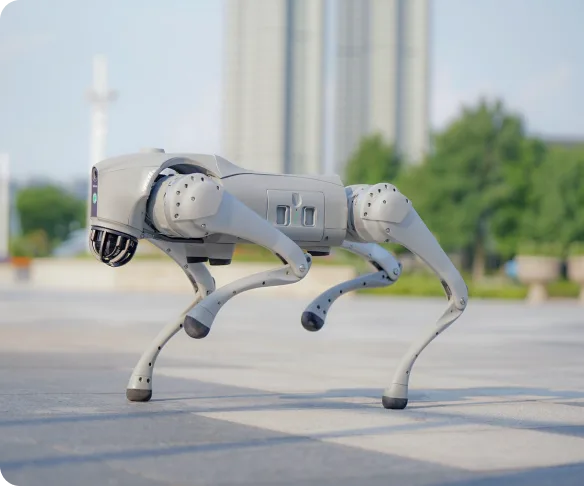
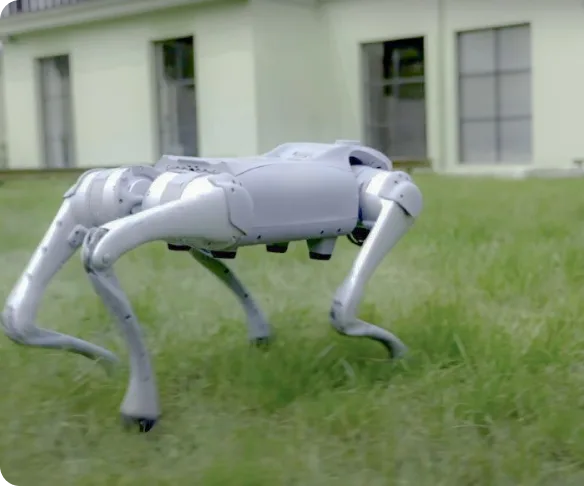
The Home Dog effortlessly maneuvers up and down stairs with precision and avoids obstacles autonomously, ensuring it never collides with walls or objects. Experience a robot designed for real-world navigation and equipped with cutting-edge technology.

TOBoRLife

Playful Entertainment For The Whole Family

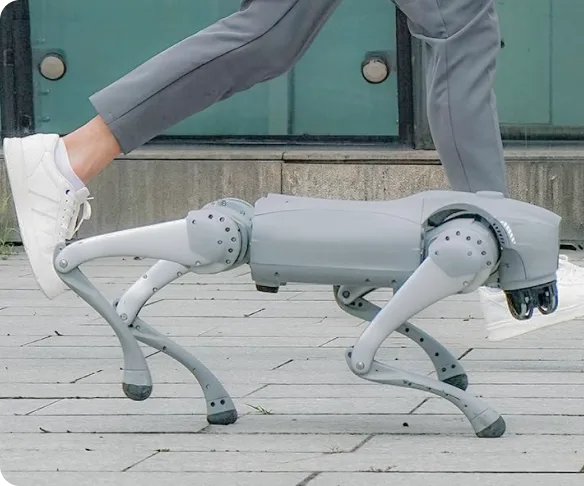
Watch in awe as the Home Dog performs captivating tricks like flips, handstands, and lively dance routines. Plus, its state-of-the-art balancing capabilities ensure smooth and stable movements, making it safe and fun for everyone to enjoy.

TOBoRLife

Camera provides security assistance for your home

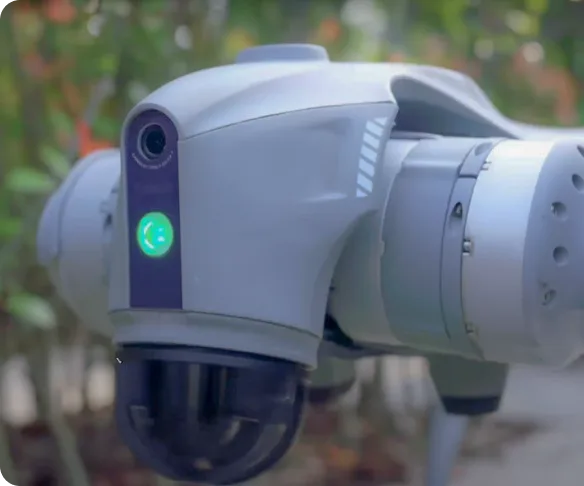
Harness the Home Dog's camera feature for comprehensive home monitoring directly from your smartphone. Utilize this versatile robot as a mobile surveillance device to enhance your home's security.

TOBoRLife

Easy to control

Take charge of the Home Dog robot effortlessly with multiple control options: the bimanual controller, the companion remote control, or the intuitive phone app. When connected to the same WiFi network as the Home Dog, harness the power of voice command via your phone, allowing the Home Dog to respond and interact using ChatGPT.

TOBoRLife

Keeps up with you

Stay in sync effortlessly with the Home Dog featuring our ISS 2.0 Intelligent Side-Follow System. This innovative technology allows the robot to smoothly track alongside you, matching your pace with precision. Experience seamless companionship and convenience like never before.