Why Teleoperation Matters in Public Robot Moments
Public robot deployments require more than impressive movement.
They require control.
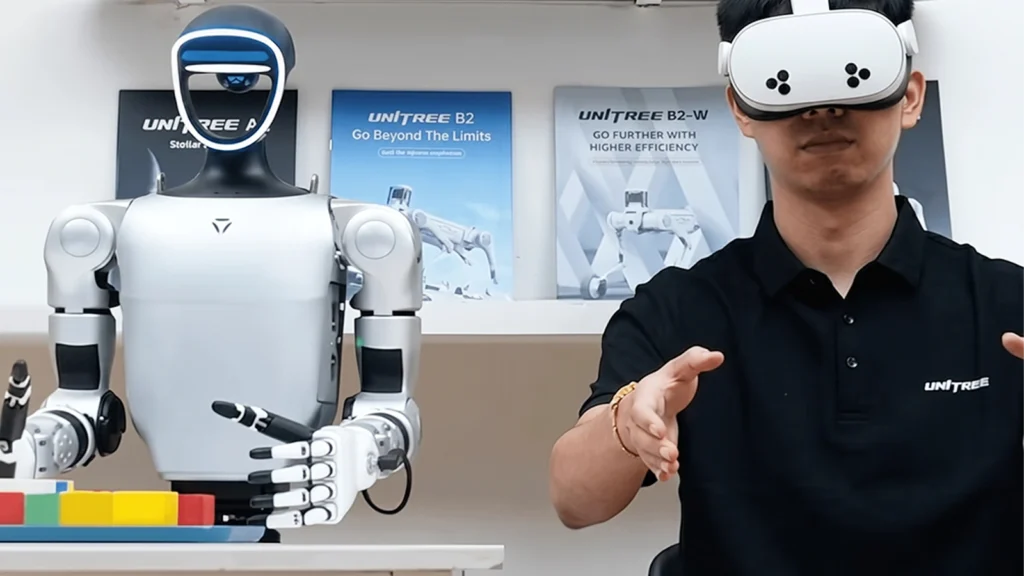
That is why teleoperation for unitree robots is becoming a serious topic for businesses exploring humanoids for events, education, and live demonstrations. Teleoperation broadly refers to remote or human-assisted robot control, allowing a person to guide, supervise, or intervene in certain robot behaviors depending on the platform, software stack, and deployment environment.
For a public-facing robot event, that matters for several reasons.
- Human oversight improves confidence
When robots are used around crowds, operators need visibility into what the robot is doing and how it is responding. - Different environments require flexibility
A stage, showroom, classroom, and conference booth all create different movement constraints. - Brands need repeatable performance
A robot activation must feel consistent, polished, and on-message. - Safety planning is part of the experience
The more visible humanoid robots become, the more important supervised operation becomes.
This does not mean every performance is fully teleoperated. Many demonstrations may combine choreography, programming, autonomy, and operator oversight. The key point is that human-in-the-loop control is becoming part of how businesses think about real-world humanoid deployment.
Toborlife AI Is Positioned for the Event Robotics Wave
As Unitree-powered humanoid robots gain visibility, more U.S. buyers are looking for a practical path to explore them. That is where Toborlife AI becomes especially relevant.
Toborlife AI focuses on making advanced robot dogs and humanoid robotics more accessible for users exploring real-world applications across events, education, research, media, and emerging physical AI use cases.
For businesses interested in a G1-style humanoid platform, products such as the Unitree G1 Edu Pro B and G1-D models create a more direct way to explore humanoid robotics through a U.S.-facing robotics provider.
That matters because most buyers are not only purchasing hardware.
They are trying to understand:
- Which robot model fits their use case
- What kind of event or demo is realistic
- How shipping and support work
- What level of technical setup is required
- Whether the robot fits education, research, or brand activation goals
- How to plan a responsible humanoid robot experience
This is especially important as unitree teleoperation and operator-assisted humanoid workflows become more visible in conversations around events and public demonstrations.
From Viral Clip to Commercial Opportunity
The AGT moment did something robotics companies have been trying to accomplish for years.
It made humanoid robots feel mainstream. Not theoretical. Not hidden inside engineering labs. Not limited to robotics conferences. Mainstream.
That visibility could accelerate adoption because it gives different audiences a clearer reason to care. Entertainment teams can imagine humanoid robots as part of live performances, stage productions, and viral video campaigns. Corporate event planners can use them to create a stronger technology presence at conferences, product launches, and executive showcases. Universities can introduce students to physical AI through live humanoid demonstrations instead of abstract lectures. Robotics educators can use platforms like G1 to make coding, motion control, and human-robot interaction feel more tangible. AI companies and startups can also use humanoid robots in investor presentations to show that their innovation is moving beyond software and into the physical world.
For creators and businesses, humanoid robots offer something digital content alone cannot: physical presence. A robot standing, moving, and interacting in the same room as an audience creates a level of attention that screens rarely match.
This is the core advantage of physical AI.It takes automation out of the browser window and places it directly into human environments. The rise of humanoid robot performances does not mean every organization should immediately put robots on stage without planning.
The best deployments usually start with a clear goal:
Is the robot meant to entertain?
- Educate?
- Attract booth traffic?
- Support a product launch?
- Create media coverage?
- Demonstrate AI capability?
- Introduce students to robotics?
Once the purpose is clear, the robot experience can be designed around that goal.
For public-facing deployments, the details matter. A humanoid robot used at a trade show needs enough open floor space to move safely and remain visible to attendees. A robot used on stage needs stable flooring, clear crowd boundaries, and a routine that matches the venue’s technical limits. If the robot is part of a school demo, the setup should prioritize operator visibility, student safety, and simple interactions that are easy to understand.
Buyers should also plan for practical logistics such as battery runtime, transportation, setup time, demo scripting, and on-site staff support. These details may seem small, but they often determine whether the robot feels like a polished technology experience or a rushed hardware demo.
This is where working with a robotics-focused provider becomes valuable. A humanoid robot can be a powerful brand asset, but the best results come when the event experience is designed intentionally.
The Bigger Trend: Humanoids Are Becoming Cultural Technology
The most important thing about the AGT performance may not be the choreography itself.
It is what the performance represented.
Humanoid robots are entering cultural spaces. They are no longer being seen only as machines for future warehouses or research labs. They are becoming part of entertainment, marketing, education, and public imagination.
That shift could have a major effect on adoption.
The more people see humanoid robots in familiar environments, the more comfortable they become with the idea of robots supporting real-world tasks. Entertainment may become one of the first bridges between advanced robotics and broader social acceptance.
That is why this moment matters for Toborlife AI and for the wider robotics market.
It shows that humanoid robots are not only advancing technically. They are becoming visible.
Final Thoughts
The Unitree G1 robots on America’s Got Talent gave the public a clear look at how quickly humanoid robotics is moving into mainstream attention. The performance combined entertainment, engineering, choreography, and physical AI into one viral moment.
For businesses, educators, and creators, the message is simple: humanoid robots are becoming powerful tools for real-world engagement.
As interest grows, Toborlife AI is helping users explore Unitree-powered humanoid robots for events, demos, education, research, and emerging physical AI applications. To learn more about available humanoid robotics options, visit Toborlife AI or contact the Toborlife AI team for guidance on which robot platform best fits your goals.

Comments are closed for this post.